Cheer and tears as African refugee rap film 'Congo Boy' charms Cannes / Photo: Valery HACHE - AFP
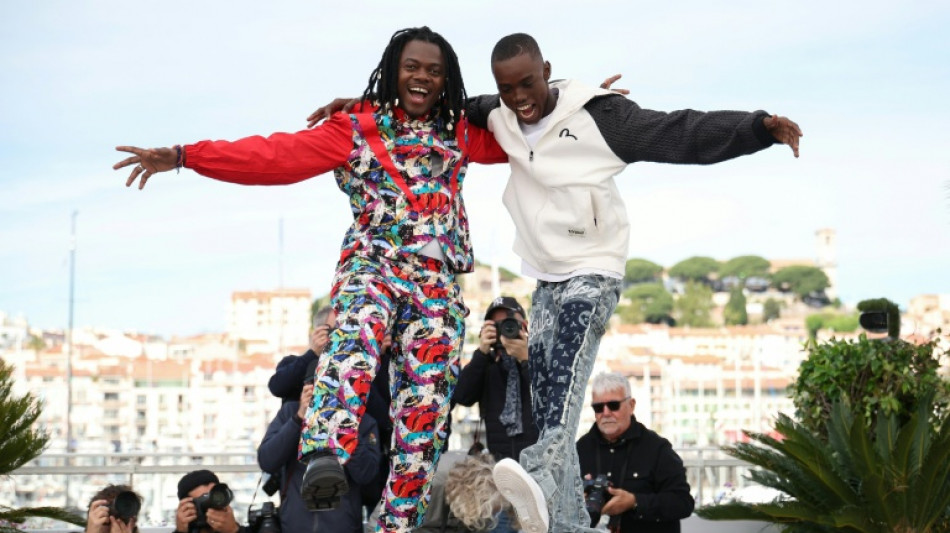
The premiere of "Congo Boy" on Friday was like no other the Cannes Film Festival has ever seen, with director Rafiki Fariala -- who also wrote its catchy soundtrack -- breaking into song to introduce his cast and crew.
The unlikely feelgood movie about a teenage Congolese refugee who has to bring up his brothers and sisters alone during the Central African Republic's bloody civil war, was hailed as a "delight" and a "total crowd-pleaser" by critics.
The rousing tale closely follows 28-year-old Fariala's own trajectory, of rising from absolute poverty -- and surviving being shot by militiamen -- to becoming a local rap star.
It's so closely based on his life, Fariala told AFP that the Muslim woman he calls his Aunt Zara plays herself in the film.
He credits her with protecting him during the vicious intercommunal violence in the Central African Republic while his Christian parents were in prison for trying to smuggle the family back to their homeland.
Fariala even used real-life soldiers and militiamen for the terrifying "authenticity they brought to screen" when he shot the film on a shoestring in the capital Bangui with a cast of non-professionals.
- 'We have dreams' -
Yet despite its heart-warming finale, which brought the audience cheering to its feet with a prolonged standing ovation, Fariala pulls no punches on the hell that he and his family went through, even showing AFP the gunshot wound he suffered from an AK-47 rifle.
Anti-Balaka gunmen left him for dead after the anti-government militia overran the compound of a colonel who had taken him and his siblings on as servants.
He was not quite 17 and his father and mother were in prison as brutal fighting raged around Bangui in 2013.
"For a year, I was completely on my own. I tried to find solutions for my family. Fortunately, music saved me. If it hadn't, I don't know if I'd be here in front of you," he told AFP in Cannes, just after the premiere.
Fariala, who became a refugee for a second time when he had to flee Bangui after some officials took umbrage at his debut documentary "We, Students", denouncing corruption in education, said he wanted to overturn the demonisation of refugees.
"Some people leave Africa to come to Europe, but there are also those who leave one African country and seek refuge in another," with more than a quarter of the world's refugees in sub-Saharan Africa.
"And that's my case: I was born in Congo, but I grew up in the Central African Republic. We fled the war. I had to hide my identity, sometimes lie" to survive.
"We're a bit like prisoners," he said.
- Muslims and Christians are 'family' -
"After watching this, I want people to see refugees differently, because young refugees have talent, have dreams, and sometimes those dreams are trampled on," he said.
Born in South Kivu in the war-torn east of the Democratic Republic of Congo, Fariala said the film is also an ode to his adopted homeland.
"For me the Central African Republic is, as I say in the song (in the film), my mother hen, my adoptive mother," he told AFP.
"I'm Congolese, but I'm also Central African at heart. It's my country. So the film is also a tribute to that mother who protected me."
Fariala said he also wanted to show how Christians and Muslims live together like "family" in Bangui, despite the bloodshed.
"We really were a family: we've always been a family. But then the war came, and politics played a role in trying to separate us."
Fariala found Bradley Fiomona Dembeasset, the 18-year-old from Bangui who plays him, in a street casting, and worked with him as much on his singing as his acting.
"It's his voice we hear in the songs -- he's the one who sang," the director said proudly, slapping his young protege on the back.
M.Arya--BD