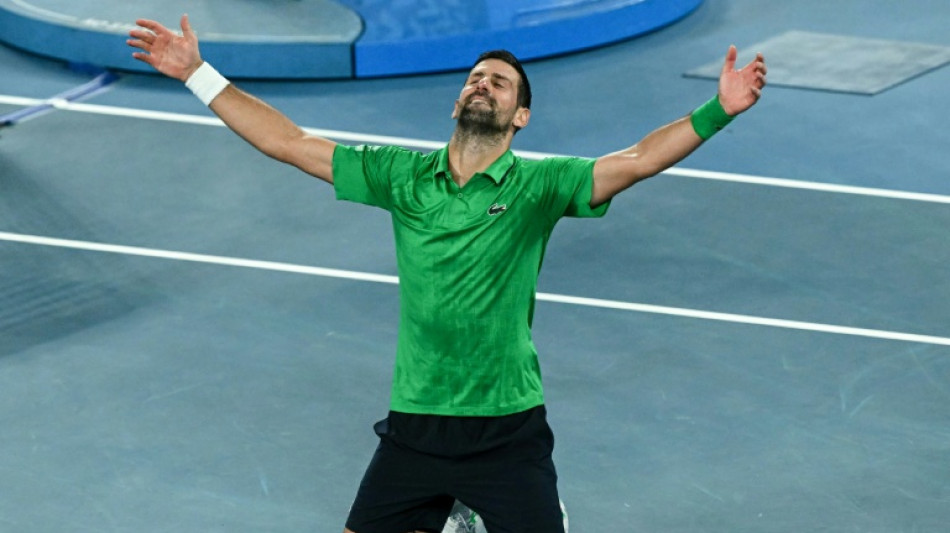
Novak Djokovic: divisive tennis great on brink of history / Photo: WILLIAM WEST - AFP
Novak Djokovic launched his career in the shadow of Roger Federer and Rafael Nadal but has surpassed them both and now stands on the cusp of tennis history.
The 38-year-old Serb will win a record 25th Grand Slam crown if he beats world number one Carlos Alcaraz in Sunday's Australian Open final.
He is tied with the Australian Margaret Court for the most majors, his 24 is two more than Nadal and four more than Federer.
Djokovic also boasts a stack of other achievements including Paris Olympic gold, 101 ATP titles and most weeks at world number one with a staggering 428.
He is the undisputed king of Melbourne Park, winning the Australian Open a record 10 times -- he has never lost a final there.
- Divisive -
Djokovic started out at a time when Federer and Nadal ruled the sport, with fans firmly in one camp or the other.
When the Serb won his first Grand Slam title, at the Australian Open in 2008, Federer was already on 12 majors and Nadal had taken virtual ownership of the French Open.
Djokovic did not win another major until 2011, but he never made any secret of his aim to be the greatest of all time.
In terms of Grand Slam titles, Djokovic has gone on to pass them both as the last remaining member of the "Big Three" of men's tennis.
But while the retired Nadal and Federer are adored by tennis fans even now, Djokovic sharply divides opinion.
He had to battle Federer and a pro-Swiss crowd in the 2019 Wimbledon final, which he won after saving match points.
Djokovic is not afraid to go toe to toe with hostile fans, using their jibes to fuel his relentless quest for glory and showing the depth of his competitiveness.
Off court he is urbane and thoughtful, and able to speak fluently in a number of languages.
An exasperated John McEnroe expressed his frustration at the way that Djokovic is sometimes treated by the Wimbledon crowds in particular.
"He's like the Darth Vader compared to two of the classiest acts we've seen play tennis -- Rafael Nadal and Roger Federer," he said.
Djokovic has shown an astonishing ability to shut out the noise and thrives when the odds are stacked against him.
After stunning two-time Australian Open champion Jannik Sinner in a five-set semi-final on Friday, Djokovic said: "I see there is a lot of experts all of a sudden that wanted to retire me or have retired me many times the last couple of years.
"You know, I want to thank them all because they gave me strength."
- War-torn beginnings -
Djokovic grew up in war-torn Serbia and has spoken about how his turbulent childhood made him hungrier for success.
He made his ATP Tour debut in 2004, winning his first title two years later.
He started to win tournaments regularly but struggled to make an impact at the Grand Slams after his 2008 triumph in Australia.
Djokovic dropped gluten early in his career, crediting the change with transforming his results.
The lithe physique of the rubber man of tennis enabled him to chase down seemingly lost causes and he combined a brutally efficient game with a rock-solid defence.
Half of his 24 Grand Slams have come after he turned 30, testament to how he has looked after himself.
He has made it clear that he has no immediate plans to retire and is eyeing the defence of his Olympic title at Los Angeles 2028.
In 2016 he became the third man in history to hold all four majors at the same time.
But agonisingly he fell at the last hurdle in 2021 as he attempted to become the first man since Rod Laver in 1969 to complete a calendar Grand Slam.
Despite his extraordinary success some personal stances have drawn criticism, such as a claim that it was possible to alter the composition of water and food through positive thinking.
His refusal to be vaccinated against Covid proved costly -- he was deported from Melbourne on the eve of the 2022 Australian Open.
And Djokovic's tennis has sometimes been overshadowed by controversies.
His infamous default from the US Open in 2020 for petulantly swiping at a ball that hit a woman line judge gave a glimpse of his fiery character.
At the 2023 French Open, he wrote "Kosovo is the heart of Serbia" on a courtside TV camera lens as ethnic tensions were again rising in the Balkans.
V.Upadhyay--BD