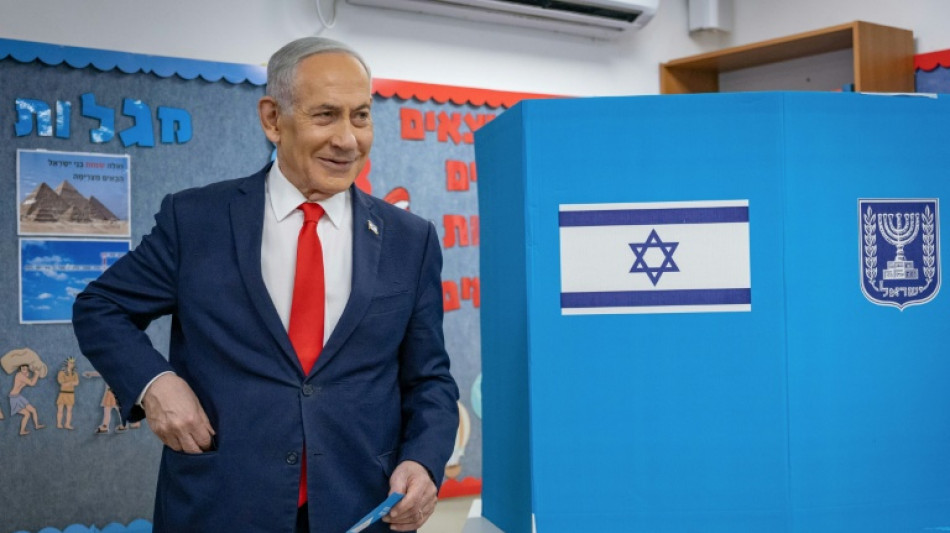
Israel opposition holds narrow edge over Netanyahu in first projections / Photo: Yonatan Sindel - POOL/AFP
Israeli voters on Tuesday gave a narrow edge to opposition parties over Prime Minister Benjamin Netanyahu, initial projections showed, after decades-high turnout in the country's first election since the trauma of the October 7, 2023 attacks.
Netanyahu, Israel's longest serving prime minister who has led the country for nearly two decades, had run on promises to fight enemies from Hamas to Iran and had spent election day raising fears of the strength of Israeli Arab voters.
Early projections broadcast by Israeli television networks showed that the bloc led by Gadi Eisenkot, a centre-right former military chief, had a narrow edge over Netanyahu's bloc which includes the far-right.
Israeli Arab parties made sweeping gains, likely giving them a critical role in the next parliament, the early exit polls showed.
With no single party winning the majority, Israeli politicians will embark on potentially weeks of high-stakes negotiations on cobbling together a coalition.
The country's main pollsters -- Channels 11, 12 and 13 -- projected the opposition bloc to win 52 to 53 seats, and Netanyahu's bloc to win around 50, although his Likud would be the largest single party in the parliament, with 24 or 25 seats.
In a dash to secure as many votes as possible, Netanyahu had charged that Israeli Arabs were out to "steal the election" and his Likud party unsuccessfully asked election authorities to keep polls open past 10:00 pm (2000 GMT).
His efforts led the opposition to charge that he was looking for pretexts to challenge the results.
"We cannot leave this battle here in the hands of the left and the Arab parties that want to bring an end to the Jewish state," a visibly tense Netanyahu told supporters as he tried to bring up turnout in a Likud stronghold.
Nationwide turnout as of 8:00 pm stood at nearly 75 percent, the highest in decades.
- Divisive rule -
Israelis cast their ballots in the shadow of October 7 and the multi-front regional wars that it sparked, with the trauma from the attack still fresh and questions over accountability and security central to the campaign.
The close-fought vote comes as Israel looks increasingly isolated on the world stage, driven by the war in Iran and the devastating military campaign in Gaza, soaring settlement construction and violence in the occupied West Bank.
Netanyahu himself faces an arrest warrant from the International Criminal Court over Gaza as well as domestic corruption charges that could land him in prison.
Eisenkot, his main rival, is a political novice and former military chief whose mild manner is seen as the antithesis of the incumbent.
Before voting, the 66-year-old Eisenkot paid his respects privately at the grave of his son Gal, whose death fighting in Gaza has drawn empathy from many Israelis.
Speaking afterwards at a polling station, Eisenkot called on Israelis to vote to replace "the worst government since the state was established".
- Arab minority in spotlight -
Some 7.3 million people were eligible to vote, with tens of thousands of Israelis estimated to have flown in from abroad for an election seen as crucial to deciding the future character of their country.
Eilana Zisblit, 55, told AFP she had travelled back from Canada, where she has lived for almost 30 years, to vote for a centre-right party in Eisenkot's bloc.
"The country is going in a really, really bad direction. Both for Jews and Arabs living in the country, and for Jews living abroad," she said.
The time to act is "now, or the country really won't survive anymore".
Netanyahu, 77, has served as prime minister on and off for more than 19 years.
Throughout his career, he has repeatedly raised the spectre of Arab voters as a threat. He warned Tuesday of Arabs voting by the busload, writing on social media that Israel could wake up to a "government of the left wing and Muslim Brotherhood".
Netanyahu said that three senior officials of the United Arab List had been arrested with envelopes full of cash in the south.
The acting director general of the Central Elections Committee, Dean Livne, said that police had "caught individuals who tried to bribe voters", adding that the unidentified suspects were not at polling stations and were caught near their homes.
He said the matter was a localised case and under investigation.
United Arab List head Mansour Abbas, who could emerge as a kingmaker in a close election, accused Netanyahu of "lying and inciting" to mobilise his voters.
Exit polls from the main Israeli television channels showed the two Arab lists winning 17 or 18 seats in the 120-member parliament between them, up from 10 in the last election in 2022.
In Tel Aviv, left-wing party The Democrats, which is part of Eisenkot's opposition bloc, said police had arrested a man with a knife who had moved threateningly towards its leader Yair Golan.
"Incitement and violence will not intimidate us," Golan said in a statement, blaming the incident on the "poison machine" of Netanyahu.
Netanyahu last returned to power in December 2022, bringing into his coalition far-right ultra-nationalists who have since seen their political clout skyrocket and have aggressively championed settlements in the West Bank.
In the last days of the campaign, he posted an image of a nuclear bomb destroying Tel Aviv and talked up his endorsement by US President Donald Trump, who is also fond of alleging election fraud.
V.Ishfan--BD