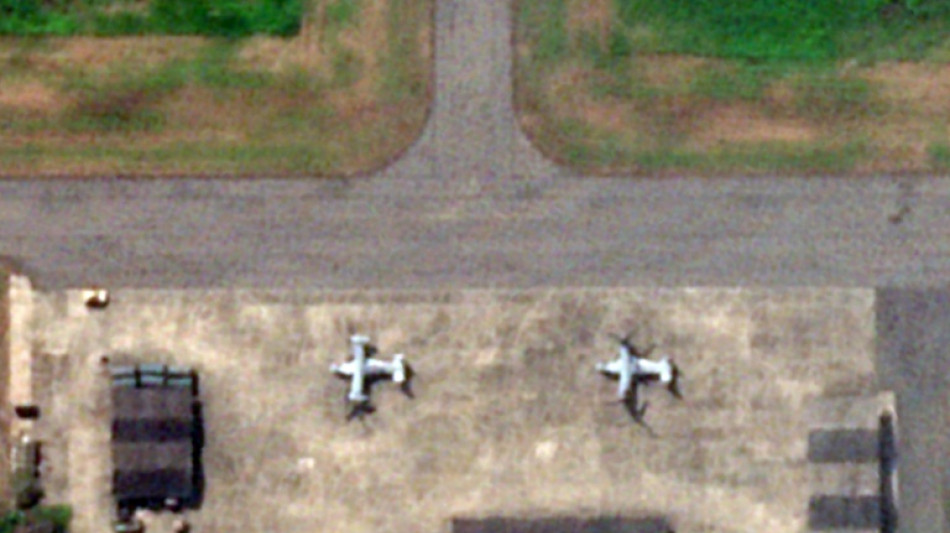
Flight data, satellite images reveal growing US role at Ecuador base / Photo: Handout - 2026 Planet Labs PBC/AFP
An isolated Ecuadoran air base has quietly become a key hub in Washington's expanding war on drug trafficking, according to flight records, satellite imagery, witnesses and military documents uncovered by AFP.
Hidden among shrimp farms and teak plantations about an hour from Guayaquil -- the Pacific port that has become the biggest gateway for Latin American cocaine bound for the United States -- the Taura complex plays an increasingly prominent role in President Daniel Noboa's security alliance with Washington.
AFP observed significant works at the decades-old facility, identified around 20 US military flights between June and mid-October, and obtained documents referring to the presence of US troops at the base.
The buildup comes less than a year after Ecuadorans voted against allowing foreign military bases, and has prompted questions from even within the highest ranks of Ecuador's armed forces.
In a letter obtained by AFP dated September 8, then Air Force commander Mauricio Salazar warned the top brass at Joint Armed Forces Command that hosting US troops at Taura, supporting the US Air Force and receiving ongoing flights by US personnel might be illegal or unconstitutional.
His letter states that the US Air Force would "use and modify infrastructure at the base" and operate "temporary support flights" from there.
Two days later, he was removed from his post.
Flight records reviewed by AFP show repeated arrivals at Taura by US military aircraft, including C-130 Hercules and C-17 Globemaster transport planes, V-22 Osprey tiltrotor aircraft and Black Hawk helicopters.
Several of the flights connected Taura with facilities in the United States, including the Cherry Point Marine Corps Air Station in North Carolina and Dover Air Force Base in Delaware, with stopovers in Puerto Rico and Panama.
Satellite imagery also shows the base undergoing significant construction work in recent months.
Several hectares of vegetation have been cleared, new operational areas have appeared around the airfield and dozens of structures consistent with rapidly deployable military tents have been installed inside the complex.
A larger structure measuring roughly 40 metres by 20 metres resembles a retractable aircraft maintenance hangar.
Outside the facility, guarded by camouflaged soldiers, AFP observed three construction trucks entering and leaving the base within 10 minutes.
Taura is the only Ecuadoran air base reserved exclusively for military use and boasts a runway of more than 3,000 metres, longer than that of Guayaquil's international airport.
President Noboa announced in September that he was working with the United States so that "any type of cooperation" between countries could be carried out there.
"I think it is much more appropriate to move everything to Taura," he said.
The Ecuadoran Air Force did not respond to a request for comment.
The Pentagon said to contact US Southern Command, which did not immediately answer questions from AFP.
- Air war -
Details of the cooperation between Quito and Washington remain closely guarded, with only occasional announcements about the arrival of aircraft and equipment.
The flights detected by AFP arrived as President Donald Trump has expanded military support for anti-cartel operations across Latin America and the Caribbean.
Ecuador's defence minister announced in August that the United States would deploy three Black Hawk helicopters as part of bilateral security cooperation.
The following month, Noboa said Ecuador would operate two MQ-9 Reaper drones, a platform used extensively by the United States for surveillance and strike missions in conflicts in the Middle East and Africa.
Retired Air Force colonel Roberto Marchan told AFP the aircraft and facilities observed at Taura suggest preparations for a long-term operational presence.
The transport aircraft identified by AFP would allow troops and equipment to move rapidly across the Andean region, he said, while some of the newly installed structures appear suitable for aircraft maintenance and logistical support.
"The US military is establishing a capability there," Marchan said. He also argued the growing American presence "diminishes sovereignty."
"There is some discontent among the rank and file, but they keep it to themselves out of respect for the institution and fear of losing promotions," he added.
- 'Nobody comes around here' -
Outside the perimeter fence, daily life bears little resemblance to the military activity unfolding inside.
A few kilometres from the base lies the town of Taura, a community of around 9,400 people connected by dusty roads and surrounded by shrimp farms.
Despite its proximity to one of Ecuador's most strategic military installations, the town lacks access to drinking water.
Residents say the area has become increasingly associated with cartel violence.
"Nobody comes around here. They think it's dangerous because sometimes bodies are found dumped," community leader Fidela Martinez said.
Last year, the bodies of four boys were found in scrubland near the town after they were tortured, killed and burned by soldiers in a case that shocked Ecuador.
Others have noticed more immediate effects from the expansion of the base.
Alma Goya, 40, runs a small food stall nearby. She said a medical center inside the military installation no longer serves the public.
"They told us it was because of the state of emergency," she said.
Not everyone opposes a foreign military presence, in a country that recorded South America's highest homicide rate last year, with 51 killings per 100,000 inhabitants.
"I saw a big plane coming in to land," said 68-year-old resident Tito Henriquez, who owns a small restaurant, adding that it would be "wonderful" to see foreign troops arrive.
As C-130 transport planes continue to arrive, bulldozers are clearing new sections of land inside the Taura complex.
str-lv-arb-dvz-nlc-pa/sms
V.Ishfan--BD