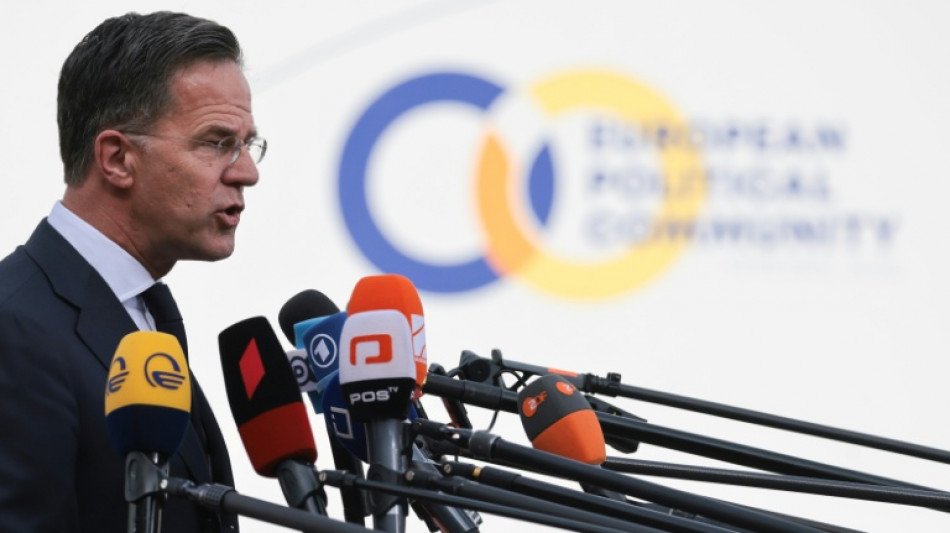
Allies jolted on defence as Trump pulls troops from Germany / Photo: Ludovic MARIN - AFP
America's NATO allies put a brave face Monday on a US decision to withdraw 5,000 troops from Germany, but warned it was proof Europe needs to step up for its own security, and fast.
US President Donald Trump cast fresh doubts over the future of the alliance as he announced Washington was to scale back its largest troops contingent in Europe, after a spat with Berlin over the Iran war.
But, gathered in Yerevan, Armenia, for a meeting of the European Political Community (EPC), European leaders and Canada's Mark Carney said they were ready to step up.
"Europeans are taking their destiny into their own hands, increasing their defence and security spending, and building their own common solutions," said France's President Emmanuel Macron.
Trump has vowed to slash US troop numbers in Europe during both his White House terms, saying he wants the continent to take on greater responsibility for its defence rather than depending on Washington.
Faced with Trump's wavering commitment and Russia's assault on Ukraine, America's NATO allies have been surging security and defence investments. Last year they pledged to boost national defence spending to five percent of GDP, under pressure from Washington.
But divisions over the Iran war seem to have precipitated events -- although German Chancellor Friedrich Merz has insisted there was "no connection" between the troop cuts and his recent row with Trump over the conflict.
"There has been a talk about withdrawal US troops for a long time from Europe," EU foreign policy chief Kaja Kallas told reporters in Yerevan. "But of course, the timing of this announcement comes as a surprise."
"It shows that we have to really strengthen the European pillar in NATO, and we have to really do more," Kallas said, while stressing that "American troops are not in Europe only for protecting European interests, but also American interests".
The Pentagon said last week the 5,000-troop reduction would take place within the next year. Trump has told reporters, without elaborating, that cuts would go "a lot further".
- 'Heard the message' -
Trump has suggested in particular he might pull troops also from Italy and Spain over them not getting behind the US-Israeli operations against Iran.
As of the end of 2025 there were 36,436 active-duty US troops in Germany, 12,662 in Italy and 3,814 in Spain.
NATO chief Mark Rutte, who was also in the Armenian capital, conceded there had "been some disappointment on the US side" over Europe's reluctance to support the US-Israeli campaign against Iran.
But Europeans had "heard the message", were now providing logistical support to US operations and pre-positioning "key assets close to theatre, for the next phase", he told reporters.
"Europeans are stepping up -- a bigger role for Europe and a stronger NATO," Rutte said ahead of the EPC meeting, dominated by the twin security threats posed by the Ukraine and Middle East wars.
Following talks with Rutte, Canada's Carney said that while there was "some concern" around adjustments in US personnel, these had to "be put against the backdrop of very, very, very considerable American resources" dedicated to NATO.
About 68,000 US troops are permanently stationed in Europe, according to figures from the US Department of Defense, with thousands of others deployed on a rotational basis, primarily in countries on NATO's eastern flank.
Total troop numbers surged to more than 100,000 following Russia's 2022 invasion of Ukraine, under Joe Biden's presidency, but have fallen gradually back since then.
In an interview with public broadcaster ARD on Sunday, Merz, who did not take part in the Armenia talks, appeared to confirm that a planned deployment of US long-range Tomahawk cruise missiles to Germany -- announced by Biden -- was also being called off.
He cited depleted arsenals because of the wars in Iran and Ukraine as the reason.
"We have to step up our military capabilities to be able to defend and protect ourselves," EU chief Ursula von der Leyen told reporters in Armenia.
V.Upadhyay--BD