Pope calls for 'law and justice' on Equatorial Guinea visit / Photo: Alberto PIZZOLI - AFP
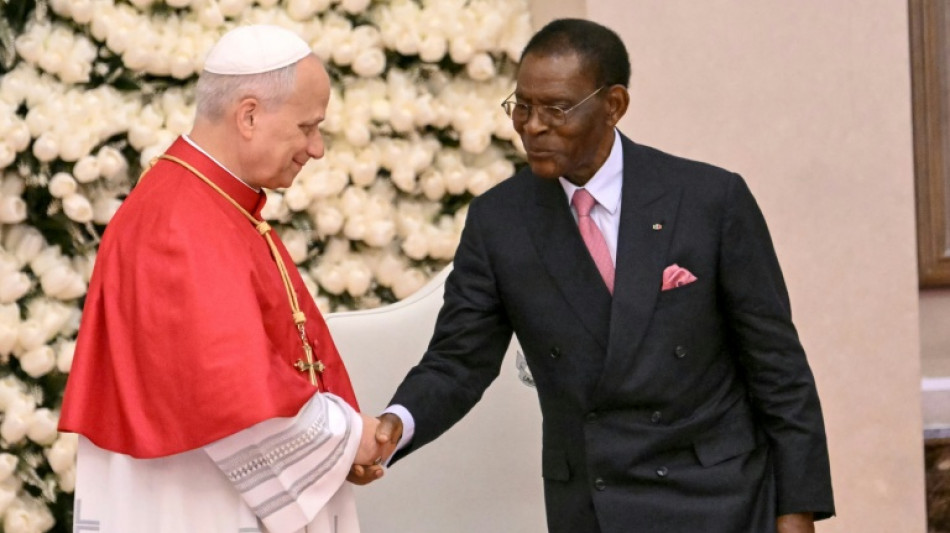
Pope Leo XIV on Tuesday urged Equatorial Guinea to place itself "in the service of law and justice", on the first day of his visit to the authoritarian country, which is one of the most closed-off states in Africa and regularly accused of human rights abuses.
The US-born pontiff arrived in the Spanish-speaking nation for the fourth and final stage of his marathon 11-day tour of the continent.
In Malabo, the former capital on Bioko island in the Gulf of Guinea, he was welcomed by Teodoro Obiang Nguema Mbasogo, who has been in power since 1979 and at 83 is the world's longest-serving head of state who is not a monarch.
At the presidential palace, the pope used a less sharp tone than on his previous three stops, calling on authorities in the country to "evaluate its own paths of development and the positive opportunities of positioning itself on the international stage in the service of law and justice".
"It is even more evident today than in years past that the proliferation of armed conflicts is often driven by the exploitation of oil and mineral deposits, occurring with no regard for international law or the self-determination of peoples," he said in a speech.
Hydrocarbon production accounts for 46.1 percent of GDP and more than 90 percent of exports in Equatorial Guinea, the African Development Bank said in 2024.
According to Human Rights Watch, "vast oil revenues fund lavish lifestyles for the small elite surrounding the president, while a large proportion of the population continues to live in poverty".
- Delicate balance -
The leader of the world's Catholics voiced regret that "the gap between a 'small minority' -- 1 percent of the population -- and the overwhelming majority has widened dramatically" while the country was bogged down in endemic corruption.
In the audience was Teodoro Nguema Obiang Mangue, known as Teodorin, who is the president's son and also vice president.
Teodorin, who was convicted in France in 2019 for money laundering and embezzlement of public funds, is known for his luxurious lifestyle that he flaunts on social media, in a country where the majority of the population lives below the poverty line.
Leo has to strike a delicate balance in Equatorial Guinea: supporting the faithful without backing the regime, which is regularly accused of authoritarianism and human rights violations, particularly in its treatment of opponents and independent media.
International NGOs accuse the government of arbitrary detentions and restrictions on public freedoms.
Leo wore a stern expression but a walkabout through the city centre streets on foot, surrounded by heavy security as well as hundreds of followers, brought back a smile to his face.
He was following in the footsteps of John Paul II 44 years ago, who was the first pope to set foot in oil-rich Equatorial Guinea, 80 percent of whose two million people are Catholic -- a legacy of Spanish colonisation.
During his flight to Malabo from Angola, Leo paid tribute to Pope Francis, a year to the day since his death.
"He lived as close as possible to the poorest, the most vulnerable, the sick, children, and the elderly," he told reporters.
- 'Our suffering' -
At Semu market, in central Malabo, reactions to the visit were mixed, with some vendors hoping to profit from the pope's arrival, while others voiced reservations.
The majority of the population remains poor despite one of the highest per capita incomes in Africa, due in particular to oil revenues.
Some feared that the country's people will have to foot the bill, including Andres Esono Ondo, who heads the country's only approved opposition party, the Convergence for Social Democracy.
Ondo feared that the trip would cause even more suffering among a population forced to bear "the economic damage", which he assumed was "something the pope does not wish for".
"For the pope to come among us... is a divine blessing, without distinction of race or political affiliation," Jovino Abaga, a young activist from the ruling Democratic Party of Equatorial Guinea (PDGE), told AFP.
Pope Leo is due to take three flights on Wednesday, and travel to Mongomo, President Obiang's native stronghold, then to Bata, the economic capital.
F.Mahajan--BD