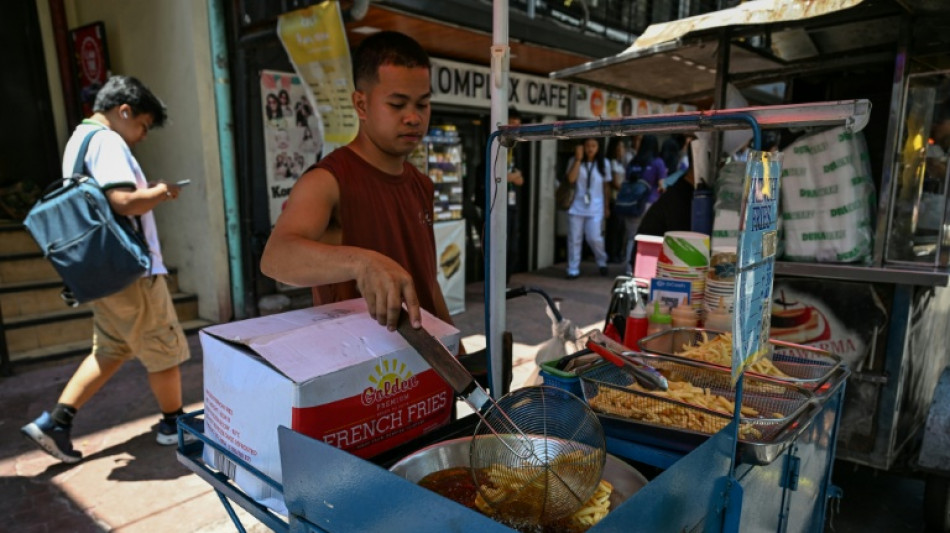
Mideast war takes a bite out of Filipino street food vendors / Photo: Jam STA ROSA - AFP
Filipinos like their "pares", a traditional beef stew, served hot -- but the soaring cost of liquefied petroleum gas has made that prospect increasingly difficult since war erupted in the Middle East.
To save a few pesos 20-year-old Eric Garcia delicately turned a knob to adjust the flame under his warming trays to the lowest setting as he grapples with fuel costs that have nearly doubled in price.
While sticker shock at petrol stations has garnered the biggest headlines since the war forced the partial closure of the Strait of Hormuz, the rising price of LPG has hit the import-dependent archipelago's humble street food vendors.
A day before speaking to AFP, Garcia said he had been forced to raise the price of a bowl of pares to 65 pesos ($1.08) after fuel costs reduced his daily earnings by a quarter.
"I'm only earning 1,500 pesos (per day), because the rest is spent on LPG," he said.
Garcia, who begins cooking at 3 am every morning before hauling his stew to a middle-class neighbourhood on a converted motorbike, said an 11 kilo tank of fuel, which typically lasts four days, that once cost 870 pesos (about $14.50) now costs 1,600 pesos.
"It's the highest price of LPG that I've ever seen since I started here," said Carlo Manalad, a supervisor at a store selling tanks of the gas, 90 percent of which is imported.
"If (our suppliers') prices are high, we also raise our prices. Our profit is still the same," the 64-year-old told AFP.
Many of the capital's streetside food sellers, however, have no such luxury.
"If we raise our prices, our customers will buy from other stalls," said Ronilo Titom, who has run a curbside canteen that caters call centre workers and jeepney drivers, for two years.
Even while holding the line on prices, Titom said he had noticed his customer base slowly shrinking since the war erupted.
"Many of them have started to bring packed lunches instead (to save money)," said the 48-year-old who, like Garcia, is using his LPG ever more judiciously.
"Sometimes we let the soup get cold," he admitted, noting that the cost of ingredients for his dishes had also been on the uptick since the war broke out.
- 'Very difficult for us' -
The Philippines revealed Tuesday war-driven inflation figures that showed food prices had increased nearly twice as fast in March as the month before.
French fry vendor John Mark Abella, 25, who has also upped his prices by five pesos to compensate for LPG costs, told AFP he believed inflation was putting the squeeze on his mostly student customers.
"I think we've got fewer customers … because they're limiting their expenses because of the high prices of fuel and food," he said.
Sam Natividad, a 25-year-old call centre worker, said that was no illusion.
"I'm limiting my expenses because... I also have to pay bills at home. I don't have a big budget for my meals here," she told AFP at a roadside canteen, adding it was "understandable" if street vendors had to raise their prices.
Near Garcia's pares stall, Allan Palong, a driver for a motorbike ride-hailing app, said he understood the vendor's need to charge five pesos more for a bowl of stew, even if his own earnings were being crippled by fuel price hikes.
"It's very difficult for us now, all prices have gone up … the five-pesos mean a lot," he said, while calling on the government to slash the excise tax on imported fuel.
"What they're doing is not enough... we can't feel it."
F.Prabhu--BD