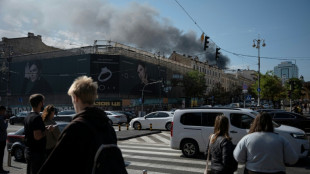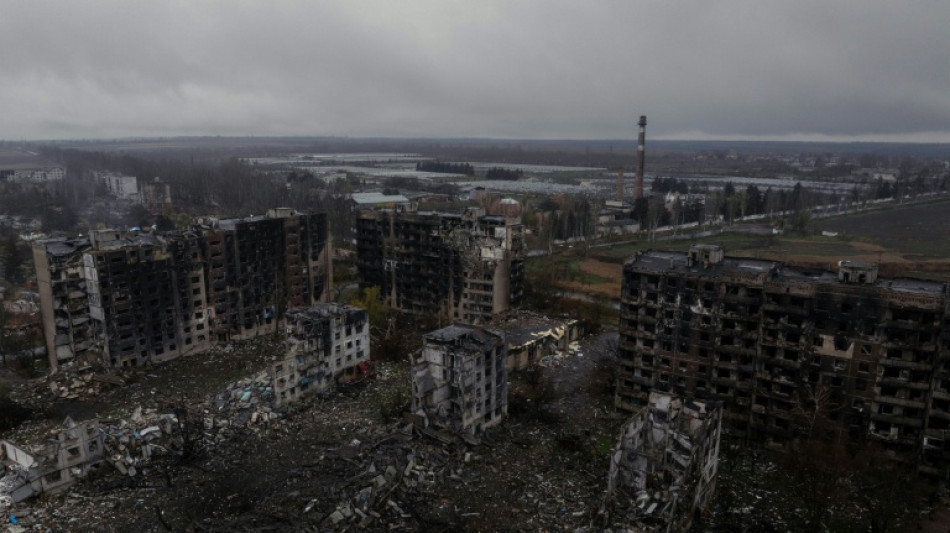
Four lives changed by four years of Russia-Ukraine war / Photo: Iryna Rybakova - 93RD SEPARATE MECHANIZED BRIGADE "KHOLODNYI YAR"/AFP
Tens of thousands of civilians and hundreds of thousands of soldiers have been killed in the Russia-Ukraine war.
In Ukraine, millions more have had to flee their homes to escape the fighting as Russia's troops advanced. And any Russians who oppose the fighting have either been arrested in a sweeping crackdown on dissent or fled the country to escape persecution.
Ahead of February 24 -- which will mark four years since Russia invaded -- AFP looks at how the lives of just four people were forever changed by the war.
- A family destroyed -
Kira was just three months old, her mother Valeria, 28, and grandmother Lyudmila, 54, when a Russian missile slammed into their apartment in the Ukrainian city of Odesa.
In a matter of seconds on April 23, 2022, they were killed -- three generations of one family wiped out.
Kira's father, Yuriy, was out shopping when the missile hit. Footage from the time showed him, visibly in shock, sifting through the rubble for items that belonged to his wife and baby daughter.
A former lawyer who had retrained as a baker at a trendy cafe in the Black Sea city, he joined the Ukrainian army a year later.
By September 2023, he had been killed -- fighting around the eastern city of Bakhmut, one of the bloodiest spots of the sprawling front line.
Their story -- the Glodan family -- has become a symbol of the enormous price paid by Ukrainian civilians since Russia invaded.
"There are hundreds of stories like this across the country," said Valeria's best friend Alla Korolyova, who AFP spoke to in February 2026.
"Lera was a ray of sunshine. She loved Odesa, Ukrainian culture, the opera," she said, using Valeria's diminutive name.
"She had a huge laugh, which I miss so much."
On her phone she shows a picture of Kira, sent to her by her mother -- a little baby she never had time to get to know.
- The amputee ready to fight again -
Russia launched its full-scale invasion of Ukraine on Volodymyr's 32nd birthday.
Four years in, he is impatient to rejoin Kyiv's army -- even after losing his leg and arm in a drone strike.
Going by the call-sign "Arkhyp", he suffered life-altering wounds in 2024 when a Russian FPV drone smashed into his unit's position.
AFP had first met him a few months earlier in the northeastern Kharkiv region, where he said drones "will reach the target 90 percent of the time -- if the pilot is good".
Speaking to AFP again this January, Volodymyr recalled the incident, his recovery and how he was desperate to help the Ukrainian war effort once again.
"I lifted my head while lying down, looked at my leg, and the guy... is just sawing my leg off," he said.
He underwent 21 operations in one month -- "almost every day. Except Saturdays, when many doctors have days off".
No longer in military fatigues but a black tracksuit and with a prosthetic limb, Volodymyr was speaking at a football tournament in the town of Pavlograd, one he used to play in before his injury.
He got around the venue with apparent ease.
His mind set on re-enlisting, he has been in constant treatment and rehabilitation for the past 18 months.
"From the very beginning, I planned to return to my brothers-in-arms," he said.
This time to a rear-line position.
Despite his unwavering determination to fight, Volodymyr had "some hope" an agreement to end the war can be reached soon.
And his priorities on what that peace deal might look like have changed.
"A couple of years ago, we firmly believed that we would be able to return to the 1991 borders," he said, referring to a time when Crimea and the eastern Donbas region were fully under Kyiv's control after the fall of the Soviet Union.
"But now, being in the army and experiencing everything firsthand, you feel that the price for the 1991 borders will be very high."
- Russian pro-war comedian revives career -
Russian comedian Andrei Bocharov, 59, made his name as a clean-cut "Mama's boy" playing an awkward character in an absurdist 1990s TV show about post-Soviet life.
Out of the limelight for years, when Russia invaded Ukraine he transformed himself into a pro-war zealot, blasting the "decadent" West and reviving his stalled career.
Known as Bocharik, the Siberian native had embodied a brief era when Russia laughed at its own flaws in "33 Square Metres", a cult hit that caricatured family life in a cramped apartment building after the collapse of the Soviet Union.
His innocent smiles and genial facial expressions won over millions of viewers.
But since February 24, 2022, he has embraced a fervent anti-West pro-Kremlin narrative.
On podcasts and social media he speaks of choosing "my homeland and my roots". He denounces those who oppose the Russian offensive and takes biting, sarcastic aim at Russians who fled the country in protest or to avoid being drafted to fight.
Before the war, he travelled extensively to Europe and the West, like most of Russia's cultural elite.
Now he slams their "anti-Russian" agenda and excessive liberalism -- echoing Kremlin talking points -- to his 400,000 followers on Telegram and Russian social media site VK.
He also hosts a weekly show on state-run radio station Sputnik.
"We are number one because we have a soul and not just money, and our guys at the front prove it every day," he said in a recent show.
"Russia always wins. We are Russians, and borscht is with us!", he says frequently -- a reference to the traditional bright red beetroot soup, claimed by both Ukraine and Russia as their national dish.
- The silent opponent -
Varvara went to an anti-war protest in Moscow the day Russia invaded and then lost her job after signing a petition against the Russian invasion.
"I warned loved ones that I might be arrested, leaving a spare set of keys and hoping my cat wouldn't starve in my absence," she told AFP.
Varvara, who asked for her name to be changed, managed to avoid being caught in a massive crackdown on street protestors.
As Russia passed sweeping military censorship laws in the days that followed, waves of her friends left the country.
"I did have the thought that I probably needed to leave," she told AFP in Moscow recently. "But at the same time I didn't understand how, where, and on what money I would live."
The knock at the door from masked police that she was half-expecting never came and she got a new job with a non-profit organisation.
It took her two years to be able to feel happiness in her daily life without guilt over the war being waged by her country, she said.
Married to a man with a child from a previous relationship, she has stopped speaking out.
"I feel responsible. And I know I want children. I can no longer afford to take this kind of optional risk," she said.
Most anti-war Russians still in the country see staying silent as the only way to avoid being thrown in jail.
Still, the conflict dominates Varvara's life -- including her relationship with her father.
He works in the security services, fought in Ukraine, and regularly offers financial help.
"He's my father, I love him. But for me, it's impossible to accept this money," she told AFP.
As for the future of Russia? She is pessimistic.
"I don't believe it's possible to change the regime in the current situation. Any resistance from below will be crushed. I just hope we, simply physically, live through this."
B.Chakrabarti--BD