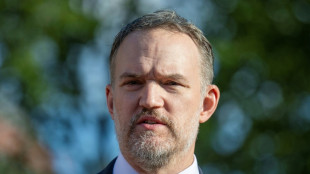
Russia lashes out at Zelensky ahead of new Trump meeting on Ukraine plan / Photo: Jim WATSON, Tetiana DZHAFAROVA - AFP/File
Ukrainian President Volodymyr Zelensky is to meet President Donald Trump in Florida this weekend, but Russia accused him and his EU backers Friday of seeking to "torpedo" a US-brokered plan to stop the fighting.
Sunday's meeting to discuss new peace proposals comes amidst Trump's intensified efforts to broker an agreement on Europe's worst conflict since World War II which has left tens of thousands dead since February 2022.
The latest plan is a 20-point proposal that would freeze the war on its current front line but open the door for Ukraine to pull back troops from the east, where demilitarised buffer zones could be created, according to details revealed by Zelensky this week.
Zelensky's office said a meeting with Trump is "planned" for Sunday in Florida, where the US leader has a home.
Zelensky said he held telephone talks on Friday with NATO Secretary General Mark Rutte, Germany's Chancellor Friedrich Merz, and a host of other European leaders, ahead of his latest diplomatic foray.
- Security guarantees -
The new plan formulated with Ukraine's input is Kyiv's most explicit acknowledgement yet of possible territorial concessions, and is very different to an initial 28-point proposal tabled by Washington last month that adhered to many of Russia's core demands.
Part of the plan includes separate US-Ukraine bilateral agreements on security guarantees, reconstruction and the economy. Zelensky said those were changing on a daily basis.
"We will discuss these documents, security guarantees," he said of Sunday's meeting.
"As for sensitive issues, we will discuss (the eastern region of) Donbas and the Zaporizhzhia nuclear power plant, and we will certainly discuss other issues," he added.
Russia signalled its opposition to the plan ahead of the Florida talks.
The Kremlin said Friday that foreign policy aide Yuri Ushakov had held telephone talks with US officials, and deputy foreign minister Sergei Ryabkov criticised Zelensky's stance.
- Russia accuses EU -
"Our ability to make the final push and reach an agreement will depend on our own work and the political will of the other party," Ryabkov said on Russian television.
"Especially in a context where Kyiv and its sponsors -- notably within the European Union, who are not in favour of an agreement -- have stepped up efforts to torpedo it."
He said the proposal drawn up with Zelensky input "differs radically" from points initially drawn up by US and Russian officials in contacts this month.
"Without an adequate resolution of the problems at the origin of this crisis, it will be quite simply impossible to reach a definitive accord," Ryabkov added.
He said any deal had to "remain within the limits" fixed by Trump and Russia's President Vladimir Putin when they met in Alaska in August, or else "no accord can be reached".
Zelensky said this week there was still disagreements between Kyiv and Washington over the two core issues of territory and and the status of the Zaporizhzhia plant.
Washington has pushed Ukraine to withdraw from the 20 percent of the eastern Donetsk region that it still controls -- Russia's main territorial demand.
It has also proposed joint US-Ukrainian-Russian control of the Zaporizhzhia, Europe's largest nuclear plant that Russia seized during the invasion.
Zelensky said he could only give up more land if the Ukrainian people agree to it in a referendum, and he does not want Russian participation in the nuclear plant.
Ukraine did appear to have won some concessions in the new plan, which, according to Zelensky, removed a requirement for Kyiv to legally renounce its bid to join NATO as well as previous clauses on territory seized by Russia since 2014 being recognised as belonging to Moscow.
Moscow has however shown little inclination to abandon its hardline territorial demands that Ukraine fully withdraw from Donbas and end efforts to join NATO.
It also wants a ban on Western countries deploying peacekeeping troops in Ukraine and sweeping political and military restrictions that Kyiv says are tantamount to capitulation.
Zelensky said Ukrainian negotiators were not directly in touch with Moscow, but that the United States acted as intermediary and was awaiting Russia's response to the latest proposal.
He expressed scepticism over whether Moscow genuinely wanted to halt its invasion.
"Russia is always looking for reasons not to agree," he said.
T.Deshpande--BD