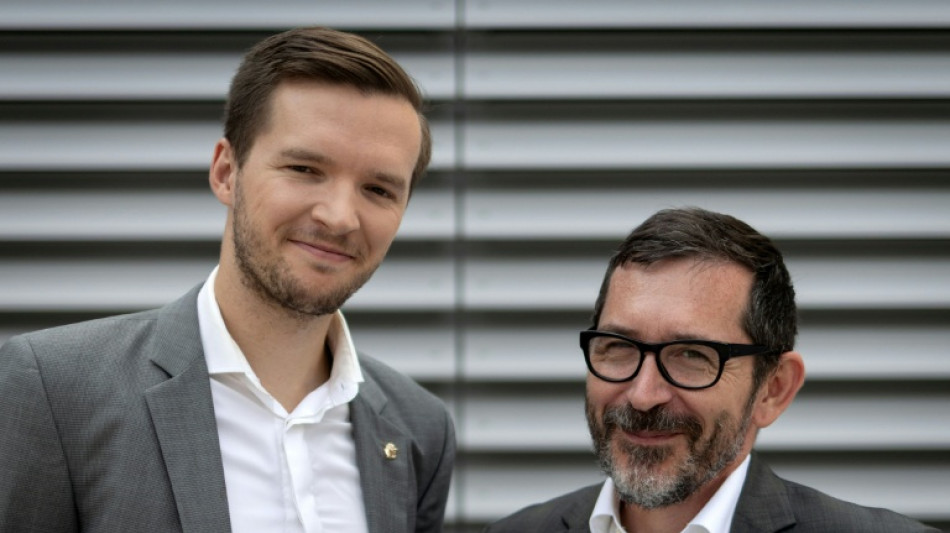
Same-sex couple takes fight for equality to Slovakian court / Photo: TOMAS BENEDIKOVIC - AFP
Slovakian lawyers Ivan Novotny and Metod Spacek got married in Austria in 2020, but their home country refused to register their marriage -- a decision they are now challenging in court.
Novotny, 31, and Spacek, 51, say nationalist Prime Minister Robert Fico's government is violating an EU court ruling that all bloc members must recognise a same-sex marriage recorded in another member.
They are challenging the Slovakian decision in court in the central European country, where Fico's government has tightened LGBTQ rights and insists national law takes precedence over EU law.
"We don't want to feel like second‑class citizens," Novotny told AFP in an interview.
Slovakia has long been one of Europe's most difficult environments for LGBTQ people.
Public support for equal rights stands at just 35 percent, according to the latest Eurobarometer on Discrimination in the European Union -- among the lowest scores in the EU.
In 2022, two men were shot dead by the son of a prominent member of an extreme-right party in front of a Bratislava gay bar.
Fico, who returned to power in 2023, has vowed to build "a barrier against progressivism" and last year changed the constitution to "recognise only two sexes, male and female" in a setback for LGBTQ rights.
Novotny and Spacek said many of their queer friends have already moved abroad.
- 'Politicisation' -
Novotny and Spacek filed a lawsuit last month against the civil registry after they received a letter signed by Interior Minister Matus Sutaj Estok himself in August, denying their request to register their marriage.
They base their case on last year's Court of Justice of the European Union ruling that says all EU members must recognise a same-sex marriage recorded in another EU state.
No date for a hearing has been set as yet.
Fico, a four-time premier and supporter of US President Donald Trump, has also personally commented on the case.
"The registration of same-sex marriages is not possible... as it is non-existent under Slovak law," he said in June.
"We'd look like fools in our own eyes if such a record was achieved," he added.
Novotny and Spacek -- former foreign ministry officials who are both active with different opposition parties -- said the refusal to register their union was only issued after a nine-month wait, far surpassing the deadline for such decisions.
"The sheer politicisation of a routine legal act stunned me," Spacek said.
Other couples are also considering legal action, including seeking redress at the European Court of Human Rights, according to Martin Macko, executive director of LGBTQ rights group Inakost Initiative.
Last month, the Constitutional Court struck down a 2023 petition seeking to extend legal protection to families outside marriage and opening the door to recognising same‑sex couples.
In its ruling, however, it recognised that the state has an obligation under European law to establish some form of legal recognition for same-sex couples, Macko said.
- Constitutional changes -
Fico's previous government in 2014 had already changed the constitution to define marriage as "a union between man and woman".
The most recent amendment, passed last year, states that sex cannot be modified and only authorises adoption for married couples, with rare exceptions.
The change also says Slovakia's "sovereignty" regarding "cultural and ethical questions" should override EU law, leading Brussels to launch legal action against Slovakia last November.
Fico has often clashed with the 27-nation bloc and has faced a series of protests over his policies.
Novotny and Spacek say they will stay in Slovakia for now, despite Fico's "radical rhetoric".
But if Fico wins a fifth term in elections due next year, they fear discrimination against LGBTQ people will only worsen and they may leave too, together with their son.
"LGBTQ people would not be safe," Novotny said.
A.Krishnamurthy--BD