Somalia attacks toll jumps to 116 amid appeals for aid / Photo: HASSAN ALI ELMI - AFP
The death toll from twin bombings in Somalia at the weekend has increased to 116, officials in charge of rescue operations said Monday, as the country's president issued an urgent plea for international help for victims.
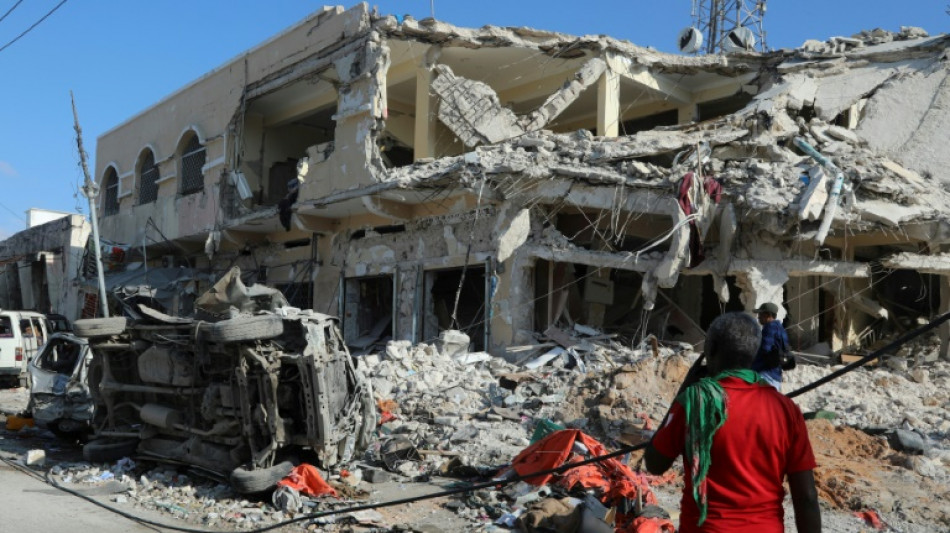
Bulldozers were still clearing the blast site in the capital Mogadishu on Monday in the hunt for bodies feared trapped under the rubble, with a committee in charge of supervising rescue efforts warning the damage was "massive".
"The number of wounded people recorded is 324... and the overall number of deaths is 116," the committee said in a statement, adding that 14 others were reported as missing.
Saturday's attack was claimed by the Al-Shabaab jihadist group and was the deadliest in the fragile Horn of Africa nation in five years.
"We appeal for the international community, Somali brothers, and other Muslim brothers and or partners to send doctors to Somalia to help the hospitals treat the wounded people," President Hassan Sheikh Mohamud said in a statement on Sunday.
He warned that the death toll could rise, as ill-equipped hospitals were swamped.
Somalia has been mired in chaos since the fall of president Siad Barre's military regime in 1991 and has one of the world's weakest health systems after decades of conflict.
"We cannot airlift all these numbers of wounded people... anyone who can send us (help) we request to send us," said Mohamud.
Prime Minister Hamza Abdi Barre has ordered schools closed so that students can take part in a national blood donation drive.
Mohamud said he himself was among several hundred people who had donated blood to hospitals for the victims.
The World Health Organization said on Sunday it was ready to help the government treat the wounded and provide trauma care.
- 'We are at war' -
Al-Shabaab, an Islamist group linked to Al-Qaeda, claimed responsibility for the attack in which two cars packed with explosives blew up minutes apart near the city's busy Zobe intersection, followed by gunfire.
It said it had targeted the country's ministry of education.
The explosions tore through walls and shattered windows of nearby buildings, sending shrapnel flying and plumes of smoke and dust into the air.
Ali Yare Ali, a local government official in Mogadishu, told reporters that between seven and nine bodies were suspected to be under the rubble of buildings destroyed by the blasts.
The attack took place at the same junction where a truck packed with explosives blew up on October 14, 2017, killing 512 people and injuring more than 290, the deadliest attack in Somalia.
The country's allies denounced the bombings, with the United States, the United Nations and the African Union among those issuing messages of support.
The attack tests the government's ability to secure the conflict-weary nation, including the capital of nearly 2.5 million people.
"The Somali nation and these terrorists are at war, as I speak now, there is fighting ongoing in many parts of the country," Mohamud said Sunday.
"We are at war with them, and we are killing each other."
- 'Horrible scene' -
Mohamud called on all Somalis to show solidarity and support those affected by the attack.
"We must get united in providing assistance to the families, children and parents of those who were martyred," he said, lauding donations of water, food and clothes to survivors.
It was not immediately clear how the cars loaded with explosives evaded the numerous checkpoints that ring-fence the coastal city.
Witnesses said the road was busy with rows of tuk-tuks and other vehicles when the first blast hit.
First responders were met with a second explosion, killing the elderly and women with children strapped on their back, police said.
"I could not sleep last night because of the horrible scene," police officer Adan Mohamed told AFP on Sunday.
Al-Shabaab fighters have stepped up their attacks in Somalia since Mohamud was elected in May and vowed an "all-out war" on the Islamists.
The insurgents have been seeking to overthrow the fragile foreign-backed government in Mogadishu for about 15 years.
They were driven out of the capital in 2011 by an African Union force but the group still controls swathes of countryside and continues to wage deadly strikes on civilian, political and military targets.
L.Apte--BD