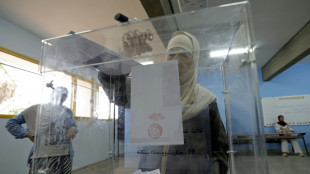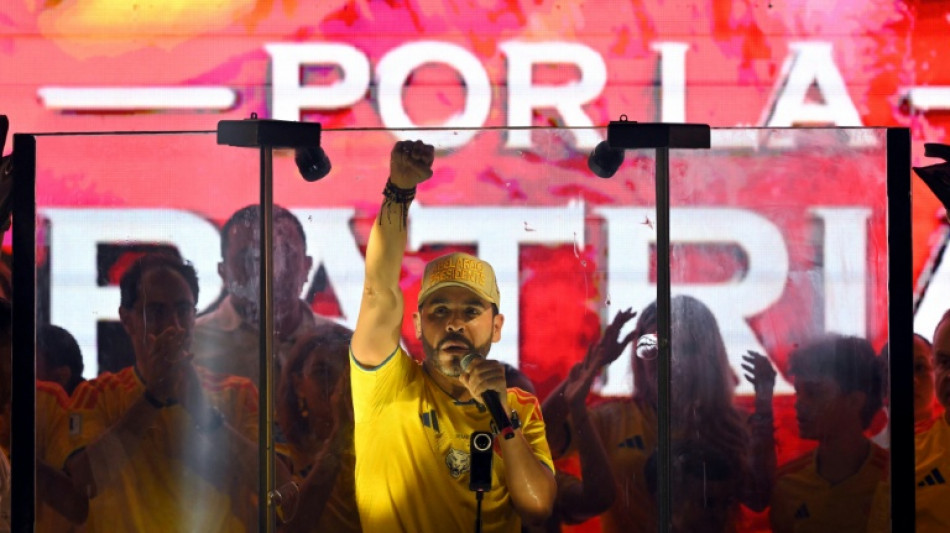
Pro-Trump lawyer, leftist senator launch Colombia runoff campaigns / Photo: Rodrigo BUENDIA - AFP
The hard-right Donald Trump fan and leftist senator vying to become president of Colombia traded insults on Monday as they threw themselves into campaigning for the June 21 election runoff.
Right-wing lawyer Abelardo de la Espriella was the surprise winner of the first round of the presidential election on Sunday, held against the backdrop of a surge in drug-related guerrilla violence.
He garnered over 43 percent, compared to 41 percent for the favorite, Senator Ivan Cepeda, with a tough-on-crime platform that has propelled right-wingers to power across Latin America.
The millionaire self-described "Tiger," who has billed himself as a norm-smashing outsider, vowed to end talks with cocaine-trafficking rebels and instead crush them with military force.
Cepeda, an acolyte of polarizing left-wing President Gustavo Petro, campaigned on keeping the struggling peace process alive and expanding social programs to reduce inequality.
"The country is quite divided... the feeling is that in the second round things will remain the same," Camilo Martinez, a 25-year-old designer in the Caribbean city of Barranquilla, told AFP.
- Stolen symbols -
In a sign of how deep the divisions run, Colombia's national football jersey has become a contested symbol just days before the World Cup begins.
Cepeda accused De la Espriella on Monday of "stealing" the yellow garment by making it a hallmark of his support, in the same way former far-right Brazilian president Jair Bolsonaro turned his country's iconic jersey into a right-wing symbol.
De la Espriella, for his part, accused Cepeda and Petro of trying to "steal democracy from us" for questioning the accuracy of Sunday's results and drew parallels with ousted Venezuelan strongman Nicolas Maduro.
Cepeda faces an uphill battle to overturn his first-round defeat.
The biggest loser of the election, however, was third-placed candidate Paloma Valencia, an establishment conservative who was endorsed by influential former president Alvaro Uribe but limped home with only seven percent of the vote.
Valencia threw her support behind De la Espriella for the runoff, against what she called Cepeda's "neocommunism."
De la Espriella "captured the spirit of anti-Petro sentiment and right-wing radicalism," Juan Nicolas Garzon, a professor of Political Science at the University of La Sabana, told AFP.
"It's going to be difficult for Cepeda," said Yann Basset, political science professor at Bogota's University of Rosario.
"He has more or less the same level of support in the polls as Petro did four years ago, so it's not impossible either," he added.
One of the questions hanging over the run-off is how centrists will vote.
Failed vice-presidential candidate Juan Daniel Oviedo, a centrist, lamented that the country was "caught between populist extremes" and refused to endorse either finalist.
While Colombia has thrived in the decade since a landmark peace accord with FARC guerrillas, pockets of the country are still gripped by armed groups vying for control of cocaine routes, illegal gold mining and extortion.
The campaign was marred by car bombs, drone attacks and the assassination of a leading presidential candidate and dozens of local politicians.
- 'Radical extremes' -
De la Espriella has vowed a "shock plan" to restore order.
"We'll start immediately with the bombing of narco-terrorist camps," he told AFP in an interview during the campaign.
He has also pledged to build 10 mega-prisons, modelled on El Salvador's brutal Terrorism Confinement Center (CECOT), where inmates, he says, will survive on "bread and water."
Cepeda, 63, is the son of a leftist senator killed by right‑wing paramilitaries. He helped broker the 2016 deal with FARC and wants to continue pursuing dialogue with other armed groups.
He has also promised to build on Petro's legacy of increasing the minimum wage, raising education spending and transferring land to poor communities.
Gloria Terranova, a 59-year-old coffee plantation worker, said she held out hope that Cepeda might still win the presidency despite finishing second in the first round.
"Right now we are at radical extremes: one side wants peace, the other wants war," she said.
E.Narula--BD