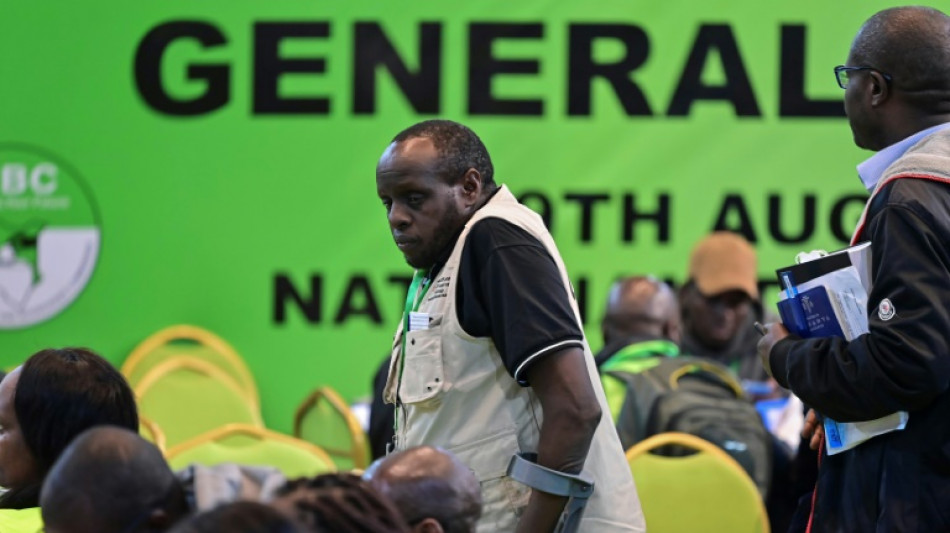
Calls for peace as Kenya awaits results of tight presidential race / Photo: Tony KARUMBA - AFP
Kenyans prayed for peace Sunday as they waited anxiously for the final outcome of the presidential election, with the two frontrunners almost neck and neck, according to partial official results.
As of Sunday morning, Deputy President William Ruto was slightly ahead of his rival Raila Odinga, data from the Independent Electoral and Boundaries Commission (IEBC) showed, before cutting off the live feed displaying the percentage of votes won by both men.
The IEBC, which has now tallied votes from over 70 percent of constituencies, did not give an explanation for the decision.
But a running tally at the Daily Nation newspaper, citing the official data, said Ruto had so far scored 52.54 percent of the vote, while Odinga had 46.78 percent.
Tuesday's vote passed off largely peacefully but after previous elections sparked deadly violence and rigging claims, the IEBC is under intense pressure to deliver a clean poll and release results by Tuesday.
Riot police were deployed overnight inside the commission's heavily guarded tallying centre in the capital Nairobi after political party agents disrupted the process, hurling rigging allegations at each other.
IEBC chairman Wafula Chebukati has accused party agents of delaying the tallying process by haranguing election workers with unnecessary questions.
More than a dozen civil society groups, trade unions as well as the Kenyan chapters of Amnesty International and Transparency International issued a statement Sunday urging calm.
"We call on all political candidates, their supporters and the public to exercise restraint. We must all avoid raising tensions that could easily trigger violence," the 14 organisations said.
The poll pitted Odinga, a veteran opposition leader now backed by the ruling party, against Ruto, who was widely expected to succeed President Uhuru Kenyatta until his boss joined hands with former foe Odinga in a dramatic shift of political allegiances.
- 'Let us have peace' -
Both candidates have pledged to maintain calm, with the memory of the 2007-08 and 2017 post-poll violence still fresh for many Kenyans.
"We have voted peacefully, we have gone through this process peacefully and it's my prayer that we end this process peacefully," Ruto, 55, said at a church service in Nairobi on Sunday.
Speaking at a separate service in the capital, Odinga, 77, recited the opening lines of the Peace Prayer of St Francis and said: "I want to become an instrument to bring peace, to heal, to unite and keep the hope alive in our country."
Worshippers in Odinga's stronghold of Kisumu also prayed for a peaceful outcome, with bishop Washington Ogonyo Ngede telling his 300-strong flock: "Don't let politics divide us. We must remain united."
"Because leaders come and go but the country of Kenya lives forever," said Ngede, a lifelong friend of the Odinga family.
"Let us have peace," he said to cheers and ululations.
In Ruto's Rift Valley bastion of Eldoret, the clergy and congregants alike called for calm and patience.
"We have come here to pray for peace, for our country, for our politicians to ask them (to) be very cautious and prudent in their utterances," said bishop Dominic Kimengich.
"We have gone through this as Kenyans, we know that any imprudent remark... can easily trigger conflict and that's what we don't want," he told AFP.
Churchgoer Mary Wanjiru, 59, told AFP she didn't "want to hear any incitement from politicians."
"We want a peaceful Kenya."
- Lower turnout -
Kenyans voted in six elections, choosing a new president as well as senators, governors, lawmakers, women representatives and some 1,500 county officials.
Lawyer David Mwaure -- one of the four presidential candidates, along with former spy George Wajackoyah -- conceded on Sunday, endorsing Ruto, whose party won a key gubernatorial race when Johnson Sakaja secured control of Nairobi, Kenya's richest city.
The election is being closely watched by an international community that views Kenya as a pillar of stability in a volatile region.
Turnout was about 65 percent, much lower than the 78 percent recorded in 2017, a reflection, some observers say, of the disenchantment with the political elite, particularly among young people.
The winner of the presidential race needs to secure 50 percent plus one vote and at least a quarter of the votes in 24 of Kenya's 47 counties.
Observers say that with the race so close, an appeal to the Supreme Court by the losing candidate is almost certain, meaning it could be many weeks before a new president takes office.
B.Chakrabarti--BD