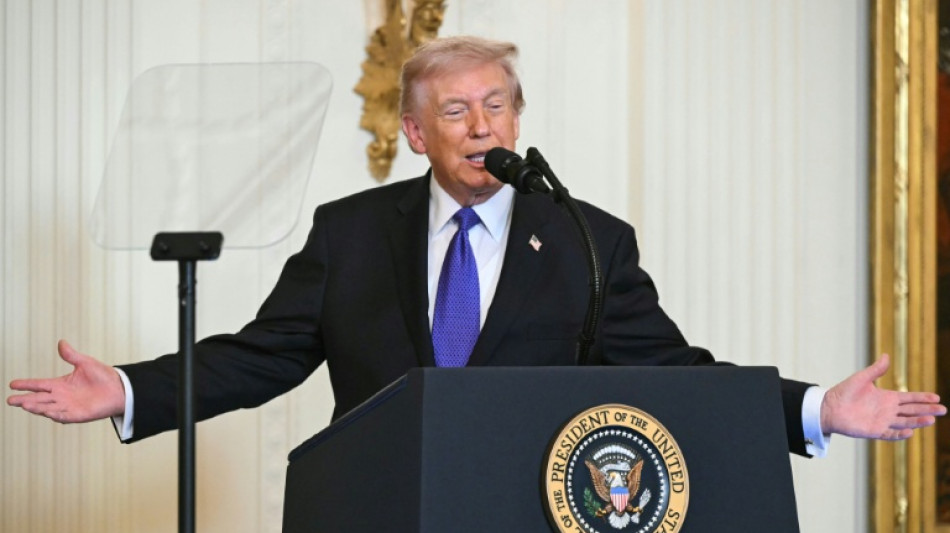
Bombing Iran, Trump has 'epic fury' but endgame undefined / Photo: SAUL LOEB - AFP
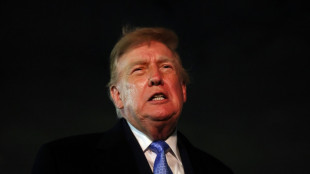
US President Donald Trump says he attacked Iran to eliminate a threat. How he sees the war ending is much less clear.
Trump at first said he was eliminating a nuclear threat. After Saturday's first strikes killed the supreme leader, Ayatollah Ali Khamenei, he called on Iranians to rise up. But Trump soon said his war launched alongside Israel was not about regime change after all.
In the end, the mission of the military operation launched by Trump and Israeli Prime Minister Benjamin Netanyahu may best be summed up by the name the Pentagon gave to it -- "Epic Fury."
Trump has threatened four weeks or more of war against the country of 90 million people, where hundreds have been reported dead, warning of even more devastating strikes.
Facing criticism over the lack of clarity, Trump and his top aides on Monday laid out four objectives for the war -- all of them military in nature.
They include destroying Iran's navy and military capacities, ending the clerical state's support for regional militants and preventing it from developing a nuclear bomb.
Matthew Kroenig, a vice president at the Atlantic Council, said that Trump had already achieved much of what he wanted, including eliminating a leader who has long been a thorn in the side of the United States. He said Trump wants to see how much would be achievable while avoiding long wars such as in Iraq and Afghanistan.
"I think they could go home almost at any time and declare this a success," said Kroenig, a former advisor to the Pentagon and to Republican candidates.
"I think the strategy is more about what they want to avoid than about exactly what they want to achieve."
Negar Mortazavi, a senior fellow at the left-leaning Center for International Policy, said that in fact Iran may reject any immediate ceasefire, believing it did not retaliate enough in previous episodes to deter another attack.
"The end goal for them is to make sure that this hurts enough and the pain is felt enough for the US, Israel and also the neighbors," she said.
- Goal of weakening Iran -
For Netanyahu, the strategy is familiar. Israel has repeatedly destroyed military infrastructure in Syria, hoping to degrade its historical adversary while it is at a weak point, even as the United States tries to bolster interim leader Ahmed al-Sharaa, a former jihadist.
Netanyahu ordered a relentless offensive that reduced Gaza to rubble after the October 7, 2023 attack by Hamas, which is backed by Iran's ruling clerics.
Before Trump, the United States has traditionally insisted on loftier principles, saying it was seeking to install democracy in its wars in Afghanistan and Iraq.
Defense Secretary Pete Hegseth, however, on Monday said that Iran was "no democracy-building exercise" and would have "no stupid rules of engagement."
Trump's goal in Iran is "not regime change, it's regime implosion," said Trita Parsi, the executive vice president of the Quincy Institute and longtime supporter of engagement with Tehran.
"The hope is that they will degrade Iran's capabilities or the repressive capacities of the state as much as possible," he said.
"From the Israeli standpoint, this is totally fine -- the more this is driven toward state collapse, not just regime collapse, the more Iran is taken off the geopolitical chessboard as a player."
Reza Pahlavi, the son of the late pro-Western shah ousted in the 1979 Islamic revolution, has voiced confidence in ending the clerical state and has called on Iranians to rise up once the moment is opportune.
The United States and Israel intervened weeks after authorities crushed massive protests, killing thousands of people.
Max Boot, a military historian and senior fellow at the Council on Foreign Relations, said that Trump's goals have been unclear on whether he is seeking regime change or a change in regime behavior.
"I think he's basically keeping it ambiguous so that whatever happens, he can claim it was a huge victory," Boot said.
"He will claim vindication no matter what happens."
R.Khurana--BD