Syria govt demands Kurdish fighters leave Aleppo neighbourhoods / Photo: Bakr ALkasem - AFP
Syria's government on Wednesday demanded that Kurdish fighters leave the neighbourhoods they control in Aleppo following clashes between the two sides which saw thousands of civilians flee.
The Syrian government and Kurdish-led forces traded blame over who started the deadly clashes on Tuesday, which killed 16 civilians and one defence ministry member.
The violence comes as the two sides have so far failed to implement a March deal to merge the Kurds' semi-autonomous administration and military into Syria's new Islamist government.
In a statement, the government expressed its "demand for the withdrawal of armed groups from the Sheikh Maqsud and Ashrafiyeh neighbourhoods".
The Syrian military shelled the neighbourhoods after declaring them "closed military zones" from 1200 GMT.
An AFP correspondent reported that the intensity of the bombardment had decreased by Wednesday evening but tanks and soldiers remained deployed around the areas.
A military source at the scene told AFP the ongoing operation was "limited" and aimed at "pressuring Kurdish fighters in the two neighbourhoods to leave the area so the authorities can extend their control to the entire city".
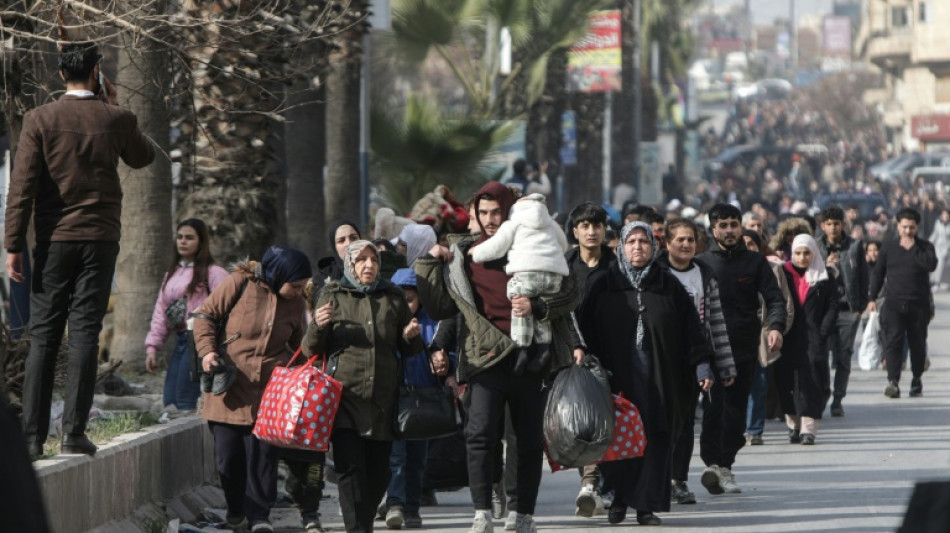
The army said it had established two "humanitarian crossings" and AFP correspondents saw thousands of civilians use them to flee with their belongings, some of them in tears.
Later, the Syrian civil defence agency said they had evacuated "more than 3,000 civilians", mostly from the two neighbourhoods.
"We fled the clashes and we don't know where to go... Fourteen years of war, I think that's enough," Ahmed, a 38-year-old man who only gave his first name, told AFP while carrying his son on his back.
Ammar Raji, 41, said he and his family were "forced to leave because of the difficult circumstances".
"I have six children, including two young ones... I am worried we will not return," Raji, who had previously escaped fighting in his northern hometown of Manbij six years ago, added.
- 'Path of reason' -
Earlier on Wednesday, the Syrian army said that "all Syrian Democratic Forces (SDF) military positions within the Sheikh Maqsud and Ashrafiyeh neighbourhoods of Aleppo are legitimate military targets", referring to the Kurdish-led force.
Senior Kurdish official Ilham Ahmed accused Damascus of launching a "genocidal war" against the Kurds, calling on the Syrian government to "pursue a path of reason to resolve problems through dialogue".
The March agreement on the Kurdish authority's integration into the state was supposed to be implemented by the end of 2025.
The Kurds are pushing for decentralised rule, an idea which Syria's new authorities have rejected.
Sheikh Maqsud and Ashrafiyeh have remained under the control of Kurdish units linked to the SDF, despite Kurdish fighters agreeing to withdraw from the areas in April.
In a statement, the SDF insisted that they had no presence in the neighbourhoods, and that the areas "do not pose a military threat in any way".
The Kurdish-led force called on Damascus to "immediately halt the siege, bombardment and military offensive targeting innocent civilians".
"The continuation of this aggression... could turn all of Syria into an open battlefield again."
Syrian authorities on their end accused the SDF of bombarding government-controlled areas.
Stephane Dujarric, spokesman for UN Secretary-General Antonio Guterres, on Wednesday said: "We call on all actors to immediately deescalate, exercise maximum restraint and take all measures to prevent further harm to civilians."
He called for "flexibility and goodwill" and the prompt resumption of negotiations to implement the March deal.
- 'Nowhere else to go' -
Schools, universities and government offices in the city were shut down on Wednesday, and authorities announced the suspension of flights to and from Aleppo airport until Thursday evening.
Joud Serjian, a 53-year-old housewife and resident of the government-controlled Syriac Quarter, said the violence "reminded us of the war".
"We have nowhere else to go, so we'll stay in our home," she added.
The SDF controls swathes of Syria's north and northeast, with the backing of a US-led international coalition, and was key to the territorial defeat of the Islamic State group in Syria in 2019.
During the Syrian civil war, Aleppo was the scene of fierce fighting between rebels and forces of ousted president Bashar al-Assad before he regained control of the city in 2016.
Assad was ousted in a lightning Islamist-led offensive in 2024.
Despite assurances from Damascus that all of Syria's communities will be protected, minorities remain wary of their future under the new authorities.
Last year, flare-ups of sectarian violence in the Alawite heartland on the Mediterranean coast and in Druze-majority Sweida province killed hundreds of members of the minority communities.
V.Upadhyay--BD