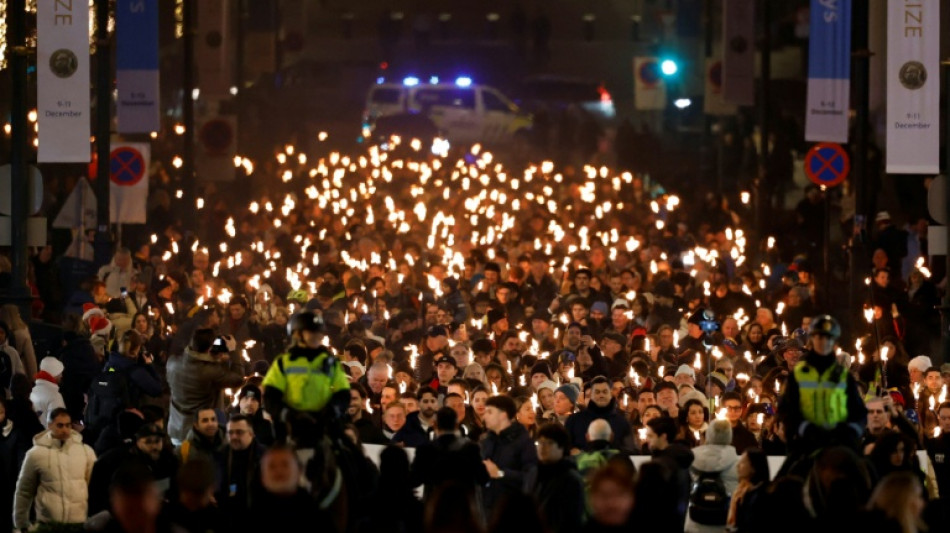
Venezuelans divided on Machado peace prize, return home / Photo: Odd ANDERSEN - AFP
Venezuelans stood divided Wednesday on the Nobel Peace Prize awarded to opposition leader Maria Corina Machado and on whether she should return home from Oslo.
Supporters were hopeful she will come back to continue leading the political resistance to President Nicolas Maduro, whose last two re-elections were widely dismissed as fraudulent.
But detractors labeled her a traitor for backing US actions against Maduro's regime, and said she would be better off in exile.
Machado, who had been in hiding in Venezuela for over a year after Maduro's disputed July 2024 re-election, traveled to Norway but missed the Nobel ceremony.
Her daughter Ana Corina Sosa Machado accepted the peace prize on her behalf Wednesday.
Nobel officials said Machado was "safe" and would reach Oslo by Thursday at the latest, when she is to hold a press conference.
Her daughter has insisted Machado would return to Venezuela despite arrest fears. Machado's former campaign manager also insisted there was "no chance" of her taking up exile.
Alirio Villegas, a 78-year-old pensioner in Caracas, told AFP if it were him, he would stay away.
"It's hard to see her coming back. This country is tough," he said. "But she has to return... she's the one leading us. If she leaves, what will we do? She's the one the country wants."
For Jazmin Briceno, a 45-year-old teacher, the peace prize was "a good step forward" for Venezuela even as it contends with an economic crisis, mass emigration and fears of US military action against leftist Maduro.
"She's Venezuelan and she has the right to come back; they can't prevent it. We're waiting for her here," Briceno told AFP.
- 'Mother of our country' -
Outside city hall in Oslo, where the Nobel ceremony took place, there was a festive atmosphere as exiled Venezuelans gathered from around Europe and as far as Qatar to celebrate Machado's win.
Draped in the Venezuelan flag, they embraced and cheered as they tried to get closer to Machado's daughter and two sisters who had made the trip.
"It's been a great honor to be here and celebrate Maria Corina: a heroine, a mother of our country," pianist and composer Gabriela Montero told AFP after moving guests to tears with a popular song from her country, "Mi querencia," weaving in notes of the national anthem.
But the Norwegian Peace Council, an NGO grouping, distanced itself from the ceremony, concerned about Machado's failure to condemn a US military deployment in the Caribbean.
US strikes on alleged drug-smuggling boats have killed dozens, including fishermen, according to their families and governments.
Back in Caracas, too, there were critics.
Administrative assistant Abigail Castillo, 24, told AFP it was "a true disgrace that they gave the prize to that woman who has sought genocide...and a blockade of our country."
Castillo hoped Machado would not return, predicting that: "Like a thief, she'll stay hidden, living in fear of the strength of every Venezuelan defending our homeland."
The Maduro government also criticized the prize, which Vice President Delcy Rodriguez described as "blood-stained" due to Machado's support of US military action.
Rodriguez likened the Oslo ceremony to a wake, saying: "The show flopped, the lady didn't show up."
At a rally on Wednesday, Maduro told supporters that Venezuela was demanding an end to "the illegal and brutal interventionism of the United States."
But for some in Caracas, politics and prizes are not top of mind.
"You don't get to eat because Maria Corina won a prize," said 32-year-old carpenter Josmar Rodriguez.
A.Zacharia--BD