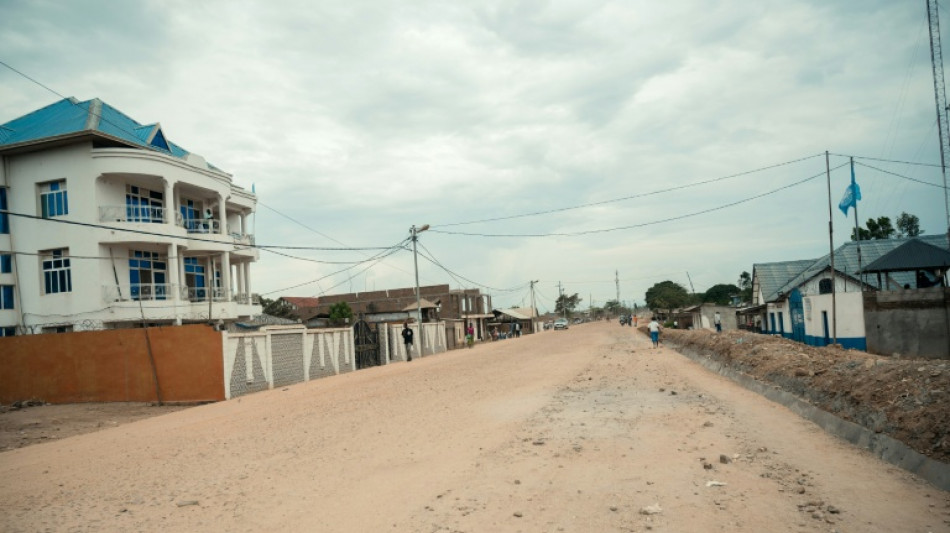
M23 tightens grip on key DR Congo city in 'middle finger' to US / Photo: - - AFP
The Rwanda-backed M23 militia captured most of the key eastern DR Congo town of Uvira late on Wednesday, in a move Burundi called a "middle finger" to the United States after the signing of a peace deal in Washington.
Eyewitness footage whose filming location was verified by AFP showed M23 tanks rolling through the streets of Uvira, while local and military sources said the militia had control of the provincial governor's headquarters, city hall and border with neighbouring Burundi.
Streets had emptied, shops shuttered and soldiers fled after the militia's entry late on Tuesday plunged the city of several hundred thousand residents into uncertainty over who was in charge.
It comes less than a year after the anti-government group seized Goma and Bukavu, two provincial capitals in the mineral-rich eastern Democratic Republic of Congo, which has been plagued by conflict for around three decades.
"I went to the border that separates our two countries; I saw that it's M23 fighters who are manning the checkpoint on the Congolese side," a Burundian army officer told AFP.
A civil society representative and a local official confirmed the presence of the group's fighters at the provincial governor's headquarters and city hall.
The latest offensive -- launched on December 1 against the Congolese army backed by Burundian forces and allied armed groups -- has further shaken hopes that an agreement brokered by US President Donald Trump will succeed in halting the conflict.
Congolese President Felix Tshisekedi and his Rwandan counterpart Paul Kagame signed the deal in Washington last Thursday.
"Signing an agreement and not implementing it is a humiliation for everyone, and first and foremost for President Trump," Burundian Foreign Minister Edouard Bizimana told AFP.
"It's truly a slap in the face to the United States, a middle finger," he said, calling for sanctions against Rwanda.
Rwanda accused the DRC and Burundi of deliberately violating the peace agreement, in a statement Wednesday. A day earlier, the United States and European powers urged the M23 to "immediately halt" its offensive and for Rwanda to pull its troops out of eastern DRC.
- Border closed -
Burundi, which neighbours both the DRC and Rwanda, views the prospect of Uvira falling to Rwanda-backed forces as an existential threat.
Uvira sits across Lake Tanganyika from the Burundian economic capital Bujumbura, with only around 20 kilometres (12 miles) between the two cities.
Burundi's main border posts with the DRC were closed on Tuesday afternoon and are now considered "military zones", military and police sources told AFP.
The M23 has closed the border on the Congolese side, according to local and military sources, though it is not yet clear whether the armed group has taken control of Uvira.
Several Congolese army soldiers and members of pro-DRC militia were still seen in the area of Uvira, military sources and witnesses said.
A few stray shots were reported.
Residents speaking to AFP by telephone reported an "every-man-for-himself" mentality and growing panic.
"The residents are locked inside their homes," one told AFP.
"We don't understand anything, we can only wait for new authorities to take over. We can't remain without an army or police," said another.
Congolese soldiers, some of whom had abandoned their weapons and uniforms, fled, looting shops and a pharmacy as they went, according to witnesses and military sources.
- Threatened -
More than 40,000 Congolese have fled the fighting and arrived in Burundi in the space of a week, the Burundian foreign minister told AFP.
According to an initial estimate by United Nations humanitarian agency OCHA, more than 200,000 people have been displaced within South Kivu province since December 2.
Meanwhile, thousands of others have crossed the border into neighbouring countries, especially Burundi but also Rwanda.
The latest advance on Uvira marks a new blow for the Congolese government.
According to several European diplomatic sources, the DRC fears the M23 pushing on towards the copper- and cobalt-rich Katanga province in the southeast, the vast country's mining hub -- which the state relies on to fill its coffers thanks to mining companies' taxes.
The peace agreement -- which Trump called a "miracle" deal -- includes an economic portion intended to secure US supplies of critical minerals present in the region, as the United States seeks to challenge China's dominance in the sector.
The M23 is supported by up to 7,000 Rwandan troops in the Congolese east, according to UN experts, who accuse Rwanda of seeking to extract the DRC's mineral wealth.
Burundi, which has thorny relations with Rwanda and fears a wider conflict in Africa's Great Lakes region, has deployed around 18,000 men to eastern DRC.
While denying giving the M23 military support, Rwanda argues it faces an existential threat from the presence across the Congolese border of ethnic Hutu militants with links to the 1994 Rwandan genocide of the Tutsis.
burs-cld/kjm/sbk/jhb
A.Krishnamurthy--BD