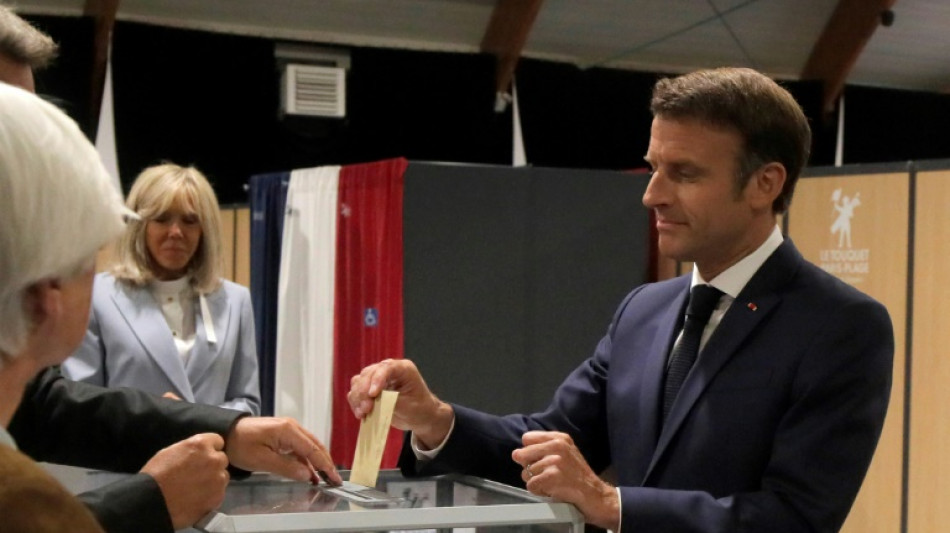
Macron to lose parliament majority in blow for reform plans: estimates / Photo: Michel Spingler - POOL/AFP
French President Emmanuel Macron on Sunday was set to lose his parliamentary majority after major election gains by a newly formed left-wing alliance and the far-right, in a stunning blow to his hopes of major reform in his second term.
The run-off election was decisive for Macron's second-term agenda following his re-election in April, with the 44-year-old needing a majority to secure promised tax cuts and welfare reform and raise the retirement age.
His "Together" coalition was on course to be the biggest party in the next National Assembly, but on 200-260 seats well short of the 289 seats needed for a majority, according to a range of projections by five French polling firms.
If confirmed, the results would severely tarnish Macron's April presidential election victory where he defeated the far-right to be the first French president to win a second term in over two decades.
The new left-wing coalition NUPES under 70-year-old hard-left figurehead Jean-Luc Melenchon was on course to win 149-200 seats.
The coalition, formed in May after the left suffered a debacle in April presidential elections, groups Socialists, the hard-left, Communists and greens.
The left only had 60 seats in the outgoing parliament, meaning they could triple their representation.
Far-right leader Marine Le Pen's National Rally party was on track for huge gains after having only eight seats in the outgoing parliament.
It was due to send 60-102 MPs to the new parliament, according to the projections.
- Ministers at risk -
Falling short of the majority would force Macron into tricky partnerships with other parties on the right to force through legislation.
There could now potentially be weeks of political deadlock as the president seeks to reach out to new parties.
The most likely option would be an alliance with -- or poaching MPs from -- the Republicans (LR), the traditional party of the French right who are on track to win 40-80 seats.
The nightmare scenario for the president -- the left winning a majority and Melenchon heading the government -- appears to have been excluded.
It has been 20 years since France last had a president and prime minister from different parties, when right-winger Jacques Chirac had to work with a Socialist-dominated parliament under premier Lionel Jospin.
The ruling party's campaign had been shadowed by growing concern over rising prices while new Prime Minister Elisabeth Borne failed to make an impact in sometimes lacklustre campaigning.
French television reports said Borne had gone to the Elysee to talk with Macron even before the projections were published.
The jobs of ministers standing for election were also on the line under a convention that they should resign if they fail to win seats.
In France's Caribbean island of Guadeloupe -- where the poll is held a day early -- Justine Benin was defeated by NUPES candidate Christian Baptiste Saturday, a loss that jeopardises her role in the government as Secretary of State for the Sea.
On the mainland, France's Europe Minister Clement Beaune and Environment Minister Amelie de Montchalin are facing tough challenges in their constituencies, with both likely to exit government if defeated.
- Bitter exchanges -
The contest between Together and NUPES has turned increasingly bitter over the last week, with Macron's allies seeking to paint their main opponents as dangerous far-leftists.
Senior MP Christophe Castaner has accused Melenchon of wanting a "Soviet revolution", while Economy Minister Bruno Le Maire called him a "French (Hugo) Chavez" after the late Venezuelan autocrat.
Macron headed to Ukraine last week, hoping to remind voters of his foreign policy credentials and one of Melenchon's perceived weaknesses -- his anti-NATO and anti-EU views at a time of war in Europe.
Macron had before embarking on the trip called on voters to hand his coalition a "solid majority", adding "nothing would be worse than adding French disorder to the world disorder".
Melenchon has promised a break from "30 years of neo-liberalism" -- meaning free-market capitalism -- and has pledged minimum wage and public spending hikes, as well as nationalisations.
Meanwhile, polling firms predicted that abstention rates would be between 53.5 percent and 54 percent, higher than the 52.5 percent recorded in the first round.
The first-round vote served to whittle down candidates in most of the country's 577 constituencies to finalists who went head-to-head Sunday.
C.Jaggi--BD