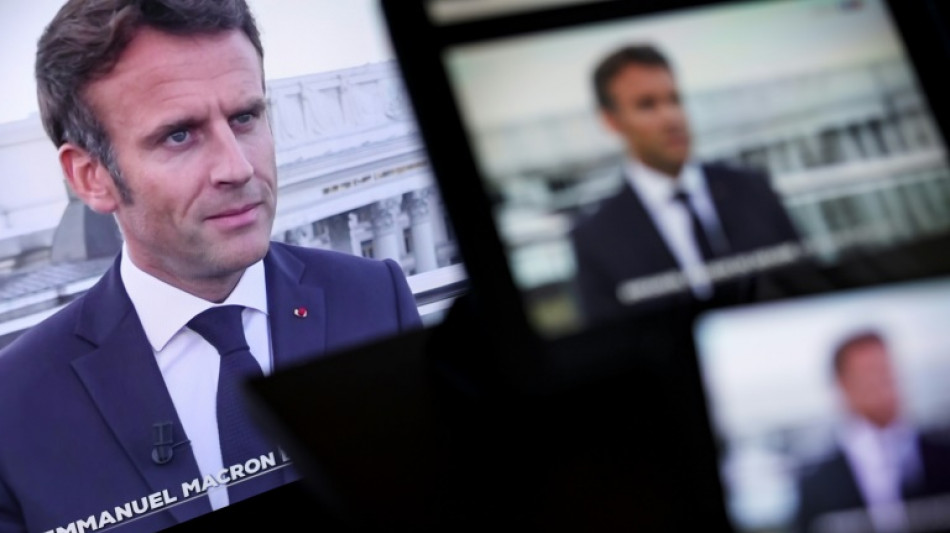
Macron's second term on line in parliamentary election / Photo: Thomas SAMSON - AFP
French voters head to the polls Sunday for the final round of parliamentary elections, with centrist President Emmanuel Macron's coalition looking to hold off a challenge from a newly formed leftwing alliance.
The vote will be decisive for Macron's second-term agenda following his re-election in April, with the 44-year-old needing a majority in order to push through promised tax cuts, welfare reform and a rise in the retirement age.
Projections from polling firms suggest his "Together" coalition is on course to be the biggest party in the next National Assembly, but possibly short of the 289 seats needed for a majority.
New left-wing coalition NUPES is hoping to spring a surprise, with the red-green collective promising to block Macron's agenda after uniting behind 70-year-old figurehead Jean-Luc Melenchon.
"The vote is extremely open and it would be improper to say that things are settled one way or the other," Melenchon told reporters on Friday during a final campaign stop in Paris.
Far-right leader Marine Le Pen is also eyeing major gains for her National Rally party, which had just eight seats in the outgoing parliament.
Macron was left disappointed by results last weekend after a first round of voting saw Together and NUPES finish neck-and-neck on around 26 percent.
Surging inflation, lacklustre campaigning from newly named Prime Minister Elisabeth Borne, and Macron's abrasive personality were all seen as reasons for the under-performance.
"I really don't believe we'll get an overall majority," one worried minister told AFP last week.
The first-round vote served to whittle down candidates in most of the country's 577 constituencies to two finalists who will go head-to-head on Sunday.
The election caps an intense two-month sequence to elect a new president and parliament, with voter fatigue seen as one of the reasons for what is expected to be record-low turn-out on Sunday.
- 'French disorder?' -
The contest between Together and NUPES has turned increasingly bitter over the last week, with Macron's allies seeking to paint their main opponents as dangerous far-leftists.
Senior MP Christophe Castaner has accused Melenchon of wanting a "Soviet revolution", while Economy Minister Bruno Le Maire called him a "French Chavez" in reference to the late Venezuelan autocrat Hugo Chavez.
Macron headed to Ukraine last week, hoping to remind voters of his foreign policy credentials and one of Melenchon's perceived weaknesses -- his anti-NATO and anti-EU views at a time of war in Europe.
"We need a solid majority to ensure order outside and inside our borders. Nothing would be worse than adding French disorder to the world disorder," Macron said.
As president, he would retain control of foreign and defence policy whatever the outcome, but his domestic agenda would be thwarted.
Melenchon has promised a break from "30 years of neo-liberalism" -- meaning free-market capitalism -- and has pledged minimum wage and public spending hikes, as well as nationalisations.
It has been 20 years since France last had a president and prime minister from different parties, when rightwinger Jacques Chirac had to work with a Socialist-dominated parliament under premier Lionel Jospin.
- Turnout key -
A final flurry of polls on Friday suggested Macron's Together allies were on track for 255-305 seats on Sunday, with only the upper end of that range being a majority of more than 289.
NUPES would secure around 140-200 seats, making them the biggest opposition force, while Le Pen's National Rally was seen to get around 20-45 seats.
If they secure more than 15 seats, Le Pen's MPs would be able to form a formal group in parliament, giving them greater visibility and resources.
But after scoring 41.5 percent in the presidential election in April, Le Pen is still struggling to convert her huge national following into major representation in parliament.
"You can put an end to five years of toxic policies by Emmanuel Macron," she said in a campaign video posted on social media on Friday.
"You also have the chance to protect the country from the far-left."
Observers will be keeping a close eye on turn-out figures following a historically low level last week of just 47.5 percent.
The three polls on Friday -- from Elabe, Ifop-Fiducial and Ipsos -- suggested turnout would be 44-47 percent.
burs-adp/sjw/gw
H.Majumdar--BD