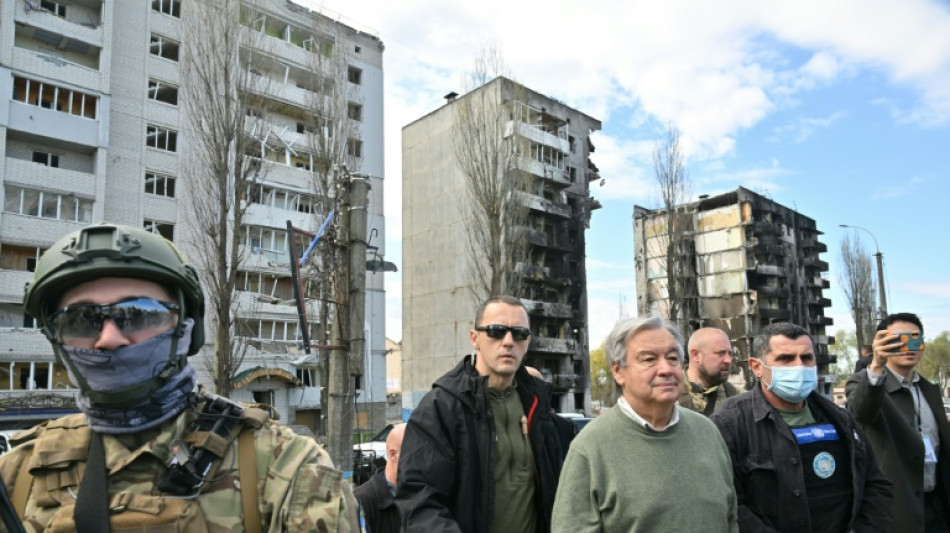
UN chief condemns 'absurdity' of war in Ukraine visit / Photo: Sergei SUPINSKY - AFP
UN Secretary-General Antonio Guterres on Thursday visited sites of alleged Russian war crimes in Ukraine, decrying war as "an absurdity in the 21st century" and urging Russia to cooperate with an international investigation into atrocities.
Making his first visit to Ukraine since Russia launched a full-scale invasion on February 24, Guterres toured several towns and villages outside Kyiv where Russian forces are accused of killing civilians.
"I imagine my family in one of those houses that is now destroyed and black. I see my granddaughters running away in panic," the UN chief said in Borodianka, a ruined town north-east of the Ukrainian capital.
"The war is an absurdity in the 21st century. The war is evil," he added.
In neighbouring Bucha, where dozens of bodies in civilian clothes, some with their hands tied behind their backs, were discovered this month after a Russian withdrawal, Guterres backed an International Criminal Court investigation into possible war crimes in Ukraine.
"I appeal to the Russian Federation to accept, to cooperate with the ICC," he implored the Kremlin.
The UN head will later meet Ukrainian President Volodymyr Zelensky. On Tuesday, he met Russian President Vladimir Putin in Moscow, repeating calls for both Moscow and Kyiv to work together to set up "safe and effective" humanitarian corridors in war-torn Ukraine.
A UN representative to Ukraine said Thursday she was preparing for a "hopeful" evacuation from the encircled port city in south-eastern Ukraine, where Kyiv says civilians and injured fighters are trapped.
"The UN is fully mobilised to help save Ukrainian lives and to assist those in need," UN in Ukraine Resident Coordinator and Humanitarian Coordinator Osnat Lubrani wrote on Twitter.
- 'Difficult weeks' -
With the war, now into a third month and claiming thousands of lives, Kyiv has admitted that Russian forces are making gains in the east, capturing a string of villages in the Donbas region.
The first phase of Russia's invasion failed to reach Kyiv or overthrow Zelensky's government after encountering stiff Ukrainian resistance reinforced with Western weapons.
The campaign has since refocused on seizing the east and south of the country while increasingly using long-range missiles against west and central Ukraine.
Ukraine's Defence Minister Oleksiy Reznikov conceded the country faces "extremely difficult weeks" as Moscow tries "to inflict as much pain as possible".
Russia's defence ministry said Thursday its forces had destroyed two arms and ammunition depots in eastern and southern Ukraine overnight with "high-precision missiles".
Its air force targeted 67 Ukrainian military sites while air defence systems destroyed a Ukrainian fighter jet in the Lugansk region, the ministry added.
Russia has also in recent days targeted Western-supplied arms, as the United States and Europe increasingly heed Zelensky's call for heavier firepower.
In a defiant speech Wednesday, Putin said if Western forces intervene in Ukraine and create "unacceptable threats", they will face a "lightning-fast" military response.
- 'Threaten security' -
"We have all the tools for this, that no one else can boast of having," he told lawmakers, implicitly referring to Moscow's ballistic missiles and nuclear arsenal.
The Kremlin reiterated the warnings Thursday, calling Western arms deliveries dangerous for European security.
"The tendency to pump weapons, including heavy weapons into Ukraine -- these are the actions that threaten the security of the continent, provoke instability," spokesman Dmitry Peskov told reporters.
Western allies remain wary of being drawn into war with Russia but have stepped up military support as Ukraine has maintained its fierce resistance.
US President Joe Biden is set to deliver remarks Thursday on "support for Ukrainians defending their country and their freedom against Russia's brutal war", the White House said.
In London late Wednesday, British Foreign Secretary Liz Truss made a fresh call for arms deliveries to Ukraine, including heavy weapons, tanks and planes, while demanding "the whole of Ukraine" must be liberated.
Responding to Putin's latest threats aimed at Kyiv's Western allies, UK Defence Secretary Ben Wallace argued he was "rolling the pitch" for a major announcement to mark Russia's World War II "Victory Day" celebration on May 9.
In its economic standoff with the West, Russia cut gas supplies to Bulgaria and Poland, both EU and NATO members, Wednesday.
- 'Blackmail' -
Brussels warned it will not waver in its support for Kyiv, accusing the Kremlin of attempted "blackmail".
Bulgarian and Poland are now receiving gas from EU neighbours, as European Commission President Ursula von der Leyen vowed an "immediate, united and coordinated" response.
With the 27-member bloc, which has depended on gas from Russia, scrambling to diversify its energy sources, she declared: "The era of Russian fossil fuels in Europe will come to an end".
European powers have imposed massive sanctions on Russia since Putin's invasion, while shipping weapons to Ukraine's defenders.
But they have moved slowly on hitting Moscow's vast exports, with many EU members -- notably industrial giant Germany -- reliant on Russian energy.
Putin has intensified pressure by insisting on payments for gas in rubles -- hoping to force his foes to prop up his currency.
Tensions have also risen in Transnistria, a breakaway region of Moldova that borders southwestern Ukraine.
The unrecognised region has reported a series of explosions in recent days that it called "terrorist attacks", leading Kyiv to accuse Moscow of seeking to expand the war further into Europe.
"We are alarmed by the escalation of tensions in Transnistria," Russian foreign ministry spokeswoman Maria Zakharova said, saying Moscow expected "a thorough and objective investigation".
burs-jj/jm
L.Apte--BD