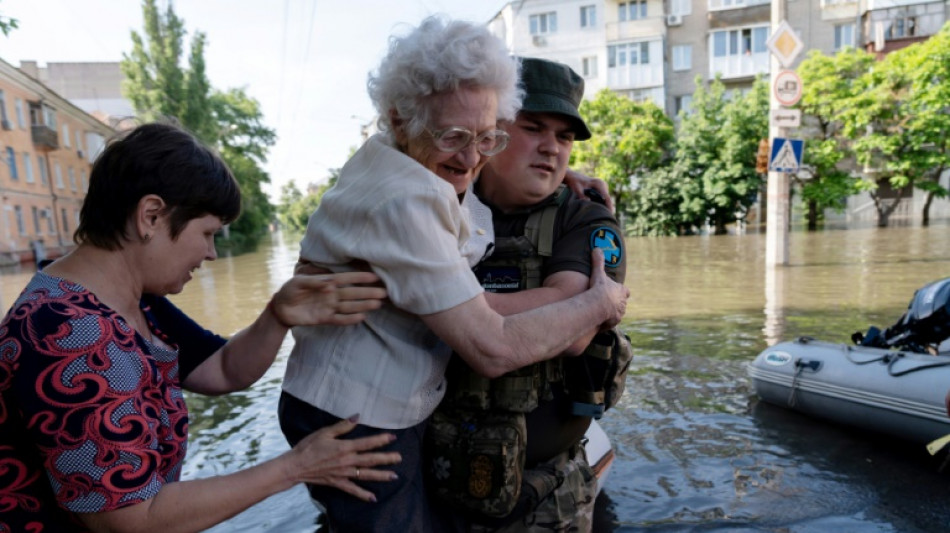
Thousands flee flooded homes after Ukraine dam destroyed / Photo: ALEKSEY FILIPPOV - AFP
Thousands were fleeing their homes Wednesday after the destruction of a frontline Russian-held dam flooded dozens of villages and parts of a nearby city in Ukraine, sparking fears of a humanitarian disaster.
Downstream from the breached Kakhovka dam, Ukrainian police and troops in Kherson city were bringing people out from inundated areas in inflatable boats, most clutching only a few documents and pets.
Moscow and Ukraine have traded blame for the dam being ripped open early Tuesday, which unleashed a gush of water on the Dnipro River and forced hasty departures.
One woman, Nataliya Korzh, 68, had swum part of the way to escape from her house. She emerged from a rescue boat barefoot, her legs covered with scratches, her hands trembling from cold.
"All my rooms are underwater. My fridge is floating, the freezer, everything. We're used to shooting, but a natural disaster is a real nightmare. I wasn't expecting that," she told AFP.
She had only managed to bring a few belongings and medicines with her and feared for her two dogs and cat, which she was unable to save.
"To get to the room where the dogs were, I would have had to dive. I don't know what's happened to them."
Central streets of Kherson were waist-deep in water and ground-floors of buildings underwater.
A spokesman for Ukraine's emergency services, Oleksandr Khorunzhyi, said on television that "more than 1,450 people have been evacuated" and "currently there is no information about the dead or injured".
Water levels in Kherson have risen by five metres (16 feet), he said.
Amid the rescue operation, frequent shelling could be heard in the city, which was occupied by Russian forces for nine months in 2022.
A policeman, Sergiy, 38, was using a radio to coordinate the rescue boats.
"Today we've already saved 30 people, 10 pets. There was one child. We will work until we've brought out all the people," he told AFP.
Washington warned there would be "likely many deaths" due to the breach of the Kakhovka dam, which is located on the frontline and provides cooling water for Europe's largest nuclear plant.
Kyiv said the destruction of the dam -- seized by Russia in the early hours of the war -- was an attempt by Moscow to hamper its long-awaited offensive, which Ukraine's leader stressed would not be affected.
The United Nations warned that hundreds of thousands could be affected on both sides of the frontline.
The head of the Kherson regional military administration, Oleksandr Prokudin, said 1,852 houses had been flooded by early Wednesday.
"According to our forecasts, the water level will increase by one metre within the next 20 hours," he warned.
President Volodymyr Zelensky's adviser Daria Zarivna said that in the occupied territory "the Russians simply abandoned people" and in the town of Oleshky on the opposite bank from Kherson, "many spent the night on the roofs of houses".
Moscow-installed officials on the Russian-occupied side of the river said on Tuesday that more than 1,200 people had been evacuated, including 38 people rescued from roofs.
- 'Environmental bomb' -
Zelensky also accused Russia of detonating an "environmental bomb of mass destruction", saying authorities expected up to 80 settlements with tens of thousands of residents to be flooded and urging the world to "react".
"This crime carries enormous threats and will have dire consequences for people's lives and the environment," Zelensky said.
But the explosion would "not affect Ukraine's ability to de-occupy its own territories", he added.
Last October, Zelensky accused Russia of planting mines at the dam, warning that its destruction would spur a new wave of refugees into Europe.
Kyiv said 150 tonnes of engine oil had spilled into the river, and the agricultural ministry said about 10 thousand hectares of farmland on the right bank of the river would be flooded and "several times more" on the left bank.
China expressed "serious concern" over the dam destruction, while EU chief Charles Michel called it a "war crime" and NATO chief Jens Stoltenberg condemned it as "outrageous".
The Soviet-era dam, built in the 1950s, sits on the Dnipro River, which provides cooling water for the Russian-occupied Zaporizhzhia nuclear power plant some 150 kilometres (90 miles) away.
Moscow and Kyiv offered conflicting assessments of the safety of the facility.
The Russian-installed director of the plant, Yuri Chernichuk, said water levels in the cooling pond had not changed and "at the moment, there is no security threat to the Zaporizhzhia nuclear power plant".
But Zelensky's aide Mykhaylo Podolyak said the nuclear plant had lost its source of cooling and the danger was "growing rapidly".
L.Panchal--BD