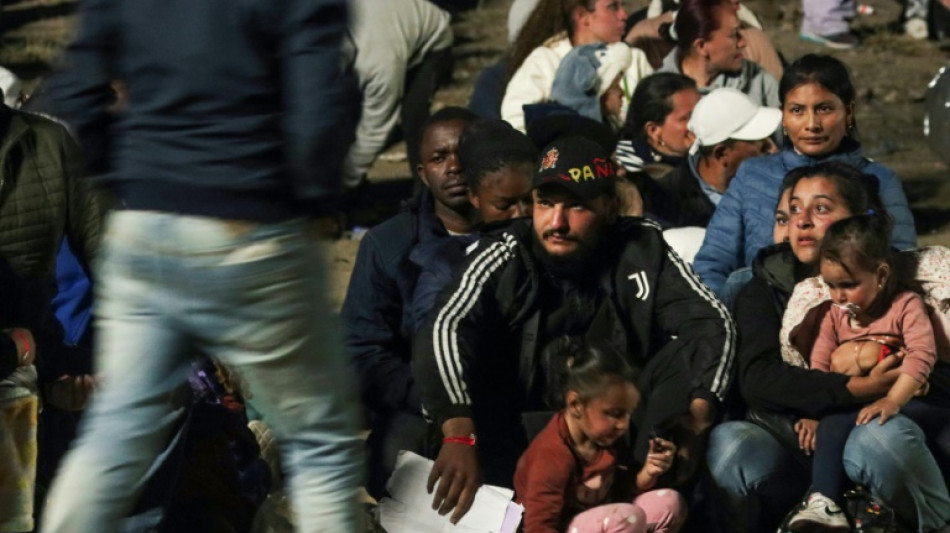
Midnight change to US migrant rules spells border confusion / Photo: Sandy Huffaker - AFP
Pandemic-era controls barring migrants from claiming US asylum expire at midnight Thursday amid fears of chaos at the Mexican border, with a tough new policy spelling uncertainty for thousands seeking refuge in America.
Large numbers of migrants, mostly from the Americas but some as far away as Asia, were on both sides of the US-Mexico frontier Thursday as US troops arrived to handle the expected surge of mainly poor people.
Some made last-minute tries to ford the narrow but fast-moving Rio Grande River near Brownsville, Texas, hoping that they might simply be released into the United States after turning themselves into the Border Patrol.
"I hope to be able to stay in this country," said 29-year-old Ecuadoran Jimmy Munoz, just after climbing onto US soil.
"But I have doubts and fears that they will let me."
For more than three years the 2,000-mile (3,200-kilometer) frontier with Mexico has been regulated by Title 42 -- a health provision designed to keep Covid infections at bay by turning people away before they made a claim for asylum.
But with the formal ending of the Covid emergency, that rule will be lifted at the stroke of midnight in the US capital -- and new restrictions will take its place.
- Glitchy app -
Those new regulations, crafted by the administration of President Joe Biden as it seeks to alleviate pressure at the border, require asylum-seekers and other migrants to request entry from outside the country.
Five-year bans or criminal charges will be levied against those who try to sneak in.
The US has pledged to set up processing centers in other countries, and is creating special refugee programs for certain countries like Haiti as well as expanding temporary work permits.
But as the looming shift inflames America's already heated immigration debate, and amid swirling misinformation, how they will play out remains in question.
Asylum-seeking migrants are required to seek interview appointments via a smartphone app -- though users report it is glitchy at best, presents a hurdle for those without working phones or wifi, and that Customs and Border Patrol can only set 1,000 appointments a day.
"It's amazing that an app practically decides our lives and our future," Jeremy de Pablos, a 21-year-old Venezuelan who has camped out in the Mexican border city of Ciudad Juarez for weeks, told AFP.
Meanwhile US cities along the border girded for the policy shift, still unsure what it would mean for them after seeing thousands of migrants appear on their streets monthly over the past three years.
"We don't know what's coming in the next day, we don't know what's coming in the next 10 days," said Oscar Leeser, the mayor of El Paso, Texas, routinely one of the busiest border crossings.
"We know that they'll continue to come and we'll continue to make sure that we help them," he told AFP on Wednesday.
- Sticks and carrots -
For much of the last year, border agents intercepted more than 200,000 migrants each month, most of whom were later expelled.
But some were allowed to register and continue into the US, and many found ways to stay there, keeping the promise alive for other migrants.
Many come from Mexico and three impoverished central American countries, Guatemala, El Salvador and Honduras -- though in recent years there has been a jump in people from Colombia, Venezuela, Ecuador, Cuba and Haiti.
The Border Patrol has also seen thousands show up each month from Russia, India, China, Brazil and elsewhere.
While Biden was heavily criticized from the left for maintaining the Title 42 policy implemented by his predecessor Donald Trump for over two years, he is now under attack from the right for lifting it, with critics predicting a surge in border crossings.
Trump -- Biden's leading Republican challenger for the presidency in 2024 -- suggested Wednesday that the coming change would be a "day of infamy."
The White House has sought to balance sticks with carrots.
"Our overall approach is to build lawful pathways for people to come to the United States, and to impose tougher consequences on those who choose not to use those pathways," Homeland Security Secretary Alejandro Mayorkas said.
That threat appeared percolate through to some migrants in Matamoros, over the border from Brownsville, Texas.
Venezuelan Andres Sanchez told AFP he would not be chancing an illegal river crossing.
"We will lose all rights to legal process. They can automatically throw us back," he said.
O.Mallick--BD