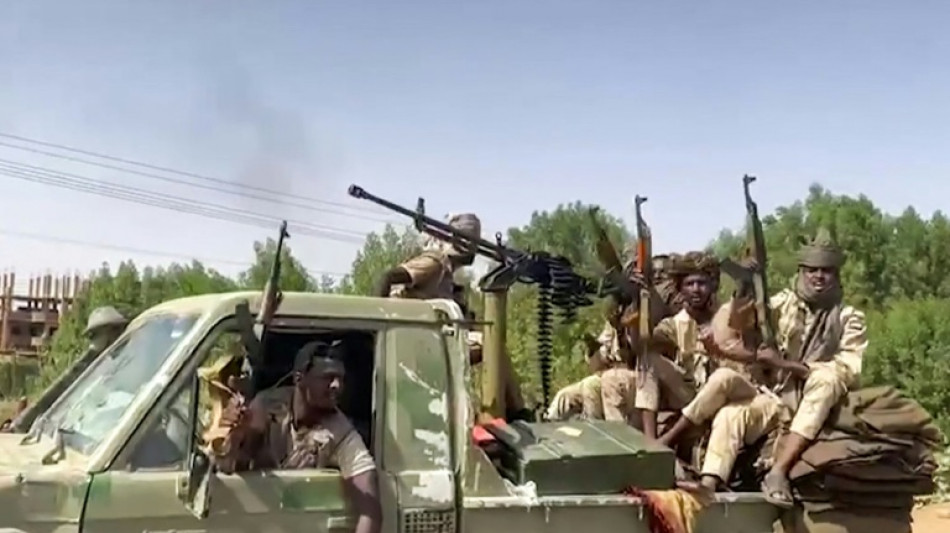
Clashes rock Sudan despite truce as ex-PM warns of 'nightmare' / Photo: - - Rapid Support Forces (RSF)/AFP/File
Heavy fighting again rocked Sudan's capital Sunday as tens of thousands have fled the bloody turmoil and a former prime minister warned of the "nightmare" risk of a descent into full-scale civil war.
Army forces clashed with paramilitaries in downtown Khartoum as deadly hostilities have entered a third week despite the latest ceasefire, which was formally set to expire at the end of Sunday.
"There has been very heavy fighting and loud gunfire every few minutes since the early morning on my street," one southern Khartoum resident told AFP by phone.
Clashes were reported around the army headquarters in central Khartoum, and the army also carried out airstrikes in the capital's twin city of Omdurman across the Nile River.
Foreign nations have scrambled to evacuate thousands of their citizens by air, road and sea since the fighting plunged the poverty-stricken country into deadly turmoil on April 15.
Millions of Sudanese have endured crippling shortages of water, food and other basic supplies, while tens of thousands have fled to neighbouring countries, with more on their way.
Satellite images showed long bus convoys at the Egyptian border, while the UN said tens of thousands had escaped to Chad, South Sudan, Ethiopia and the Central African Republic.
The turmoil could deepen further in the power struggle between army chief Abdel Fattah al-Burhan and Mohamed Hamdan Daglo, who commands the paramilitary Rapid Support Forces (RSF).
Sudan's former prime minister Abdalla Hamdok warned that the conflict could deteriorate into one of the world's worst civil wars if not stopped early.
"God forbid if Sudan is to reach a point of civil war proper... Syria, Yemen, Libya will be a small play," Hamdok told an event in Nairobi. "I think it would be a nightmare for the world."
- Risk of famine -
The fighting has affected 12 out 18 states across Sudan, including the Darfur region, the ministry said.
The UN World Food Programme has warned the violence could plunge millions more into hunger in a country where 15 million people already need aid to stave off famine.
The warring sides have agreed to multiple truces but none has taken hold, as chaos and lawlessness have gripped Khartoum, a city of five million, and other regions.
The latest three-day ceasefire -- due to expire at midnight (2200 GMT) Sunday -- was agreed Thursday after mediation led by the United States, Saudi Arabia, the African Union and the United Nations.
As the battles have raged regardless, the rival generals have taken aim at each other in the media.
Burhan again branded the RSF a militia that aims "to destroy Sudan" while Daglo called the army chief "a traitor".
Sudan was ruled for decades by Islamist-backed strongman Omar al-Bashir, who was ousted by the military in 2019 after mass pro-democracy protests.
The coup brought Burhan and Daglo to power, and they seized full control in another coup, in 2021, before turning on each three weeks ago.
- Tens of thousands flee -
UN Secretary-General Antonio Guterres has urged negotiations to end the bloodshed.
"There is no right to go on fighting for power when the country is falling apart," he told Saudi-owned Al Arabiya television on Saturday.
"My appeal is for everything to be done to support an African-led initiative for peace in Sudan."
Guterres also said on Twitter that "the UN is scaling up efforts to help people seeking safety in neighbouring countries".
About 75,000 have been displaced by the fighting, the UN said.
At least 20,000 have escaped to Chad, 4,000 to South Sudan, 3,500 to Ethiopia and 3,000 to the Central African Republic, it said.
The fighting has also triggered a mass exodus of foreigners and international staff.
Saudi Arabia said it had taken almost 4,880 people to safety on ships across the Red Sea.
A US-organised road convoy arrived in Port Sudan Saturday to join the exodus, the State Department said.
And the UK Foreign Office said just under 1,900 Britons had been taken out on 21 flights, following similar mass airlifts by France, Germany and other nations.
Fighting, looting and lawlessness have raged in the Darfur region.
In West Darfur state, at least 96 people were reported killed in the city of El Geneina, the UN said.
"What's happening in Darfur is terrible, the society is falling apart, we see tribes that now try to arm themselves," Guterres said.
Darfur is still scarred by a war that erupted in 2003 when then Bashir unleashed the Janjaweed militia, mainly recruited from Arab pastoralist tribes, against ethnic-minority rebels.
The scorched-earth campaign left at least 300,000 people dead and close to 2.5 million displaced, according to UN figures.
B.Chakrabarti--BD