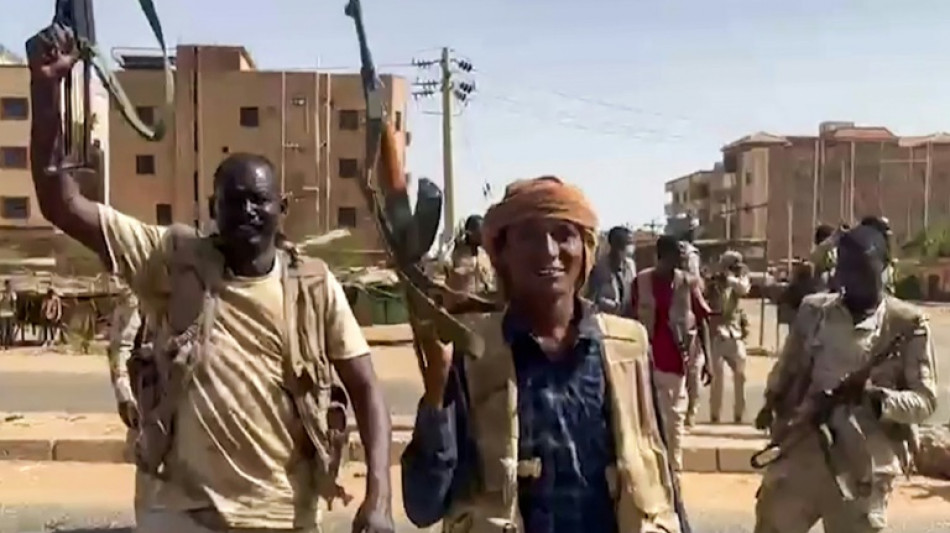
Renewed air strikes rock Sudan truce / Photo: - - Rapid Support Forces (RSF)/AFP/File
The Sudanese army pounded paramilitaries in the capital Khartoum with air strikes Thursday while deadly fighting flared in Darfur as the conflict entered a 13th day despite a US-brokered ceasefire.
Late Wednesday, the army said it had agreed to talks in Juba, capital of neighbouring South Sudan, on extending the three-day truce which expires on Friday "at the initiative of IGAD", the East African regional bloc.
There have been multiple truce efforts since fighting broke out on April 15 between Sudan's regular army led by General Abdel Fattah al-Burhan and the paramilitary Rapid Support Forces (RSF) commanded by his deputy turned rival, Mohamed Hamdan Daglo. All have failed.
The fighting has continued depite the US-brokered ceasefire that took effect on Tuesday, with warplanes patrolling the skies over the capital's northern suburbs as fighters on the ground have exchanged artillery and heavy machine gun fire, witnesses said.
Burhan agreed on Wednesday to the IGAD proposal for talks on extending the truce by a further 72 hours, the army added.
The RSF's response to the proposal remains unclear.
At least 512 people have been killed and 4,193 wounded in the fighting, according to health ministry figures, although the real death toll is likely to be much higher.
- Violence beyond Khartoum -
Beyond the capital, fighting has flared in the provinces, particularly in the war-torn western region of Darfur.
Clashes between the army and the RSF raged for a second straight day in the West Darfur capital Geneina, witnesses said, adding that civilians were seen fleeing to the nearby border with Chad.
On Wednesday, the United Nations humanitarian agency had reported killings, looting and arson in Geneina.
"An estimated 50,000 acutely malnourished children have had nutrition support disrupted due to the fighting," it added in a statement.
The heavy fighting has trapped many civilians in their homes, where they have endured severe shortages of food, water and electricity. Communications have been sporadically disrupted.
The UN has warned that as many as 270,000 people could flee into Sudan's poorer neighbours South Sudan and Chad.
Other Sudanese have sought refuge in Egypt to the north and Ethiopia to the east, but both entail long and potentially dangerous journeys overland.
The UN said it had "received reports of tens of thousands of people arriving in the Central African Republic, Chad, Egypt, Ethiopia, and South Sudan".
Cambridge University academic Sharath Srinivasan warned that the mass movement of people across Sudan's borders threatened to destabilise already fragile regimes in neighbouring countries.
"If the armed confrontation between these two forces protracts — or worse, if it draws in other armed rebel groups across the country — this could quickly become one of the worst humanitarian crises in the region and risk spilling over," he told US news outlet Politico.
Foreign governments have taken advantage of the fragile truce to organise road convoys, aircraft and ships to get thousands of their citizens out but some have warned their evacuation efforts are dependent on the lull in fighting holding.
China deployed warships on Thursday to evacuate its citizens, the defence ministry said.
- War crimes suspect escapes -
As lawlessness has gripped Sudan, there have been several jailbreaks, including from the high security Kober prison where top aides of ousted dictator Omar al-Bashir were held.
Among those who have escaped is Ahmed Haroun, wanted by the International Criminal Court for war crimes and crimes against humanity for his role in the Darfur conflict that erupted two decades ago.
Haroun's escape sparked fears of the involvement of Bashir loyalists in the ongoing fighting.
The army said the ousted dictator was not among those who escaped but had been moved to a military hospital before the fighting erupted.
Daglo's RSF emerged from the Janjaweed militia, accused of carrying out atrocities against civilians during Bashir's brutal suppression of ethnic minority rebels in Darfur in the mid-2000s.
Bashir was toppled by the military in a palace coup in April 2019 following civilian mass protests that raised hopes for a transition to democracy.
W.Atwal--BD