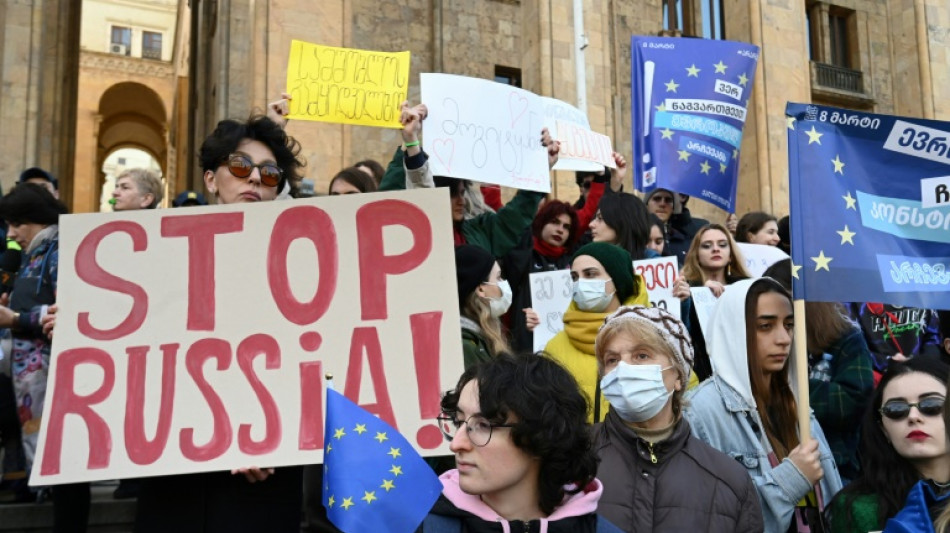
Georgians protest 'foreign agent' bill after violent clashes / Photo: Vano SHLAMOV - AFP
At least two thousand demonstrators marched through the capital of Georgia, Tbilisi, Wednesday to protest government plans to introduce a "foreign agent" law reminiscent of Russian legislation used to silence critics.
There is increasing concern that the small Caucasus republic, which aspires to join the EU and NATO, is taking an authoritarian turn and bending to political pressure from the ruling party.
On Tuesday, riot police and protesters clashed after ruling party lawmakers approved the draft law on "foreign agents" in its first reading.
Police said Wednesday more than 60 demonstrators had been detained and 50 police officers injured.
On Wednesday afternoon, marchers blocked Tbilisi's main road, chanting "No to the Russian law". An AFP correspondent put the numbers at between two and three thousand.
One of the banners read "Women against total control," a nod to International Women's Day.
"We want Europe! We want the West," Tamuna Kirkhvadze, a 37-year-old economist who took part in the march, told AFP. "We want a bright future for our children and us."
The protesters said they wanted the government to drop the bill on "transparency of foreign funding," which critics say mirrors a law used in Russia to force opposition groups to close.
Georgia's political opposition and civil society groups urged protesters to gather outside parliament Wednesday evening.
- 'Big moment' -
Tom de Waal, a senior fellow at Carnegie Europe, said that both the bill and crackdown represented a serious challenge in the politically turbulent country.
"It's a big moment for Georgia, still a democracy, but definitely a struggling one," he wrote on social media.
Late Tuesday, police used tear gas and water cannon to disperse the protesters. At that rally, some slogans also targeted Russian President Vladimir Putin.
Russia and Georgia fought a five-day war in 2008.
In Russia, the foreign agent label recalls the term "enemies of the people" of the Soviet era.
The Kremlin has extensively used the label against opponents, journalists and human rights activists accused of leading foreign-funded political activities.
Georgian authorities have faced mounting international criticism over a perceived backsliding on democracy, seriously damaging Tbilisi's ties with Brussels.
Georgian Prime Minister Irakli Garibashvili has defended his "balanced" Russia policy as aimed at ensuring "peace and stability".
But Georgian President Salome Zourabishvili has expressed support for the demonstrators and has vowed to veto the legislation.
"Today is a dark day for Georgia's democracy," the US embassy in Georgia said after the initial reading.
The interior ministry said the demonstrators had "physically assaulted" police and "thrown various objects -- stones, inflammable and blunt objects".
- Molotov cocktails -
"Later, people started an organised attack on the parliament building, throwing so-called 'Molotov cocktails' and fireworks," the ministry said in a statement.
The statement added that 66 people had been arrested for minor hooliganism and disobeying law enforcement.
Up to 50 police officers were wounded in the clashes, the ministry added, with several hospitalised.
Georgia applied for EU membership together with Ukraine and Moldova days after Russia invaded Ukraine in February last year.
In June, EU leaders granted formal candidate status to Kyiv and Chisinau but said Tbilisi must implement a number of reforms first.
Georgia's treatment of jailed ex-president Mikheil Saakashvili, whose health has drastically deteriorated in prison, has also drawn international condemnation.
Late last month, European Union member states issued a formal diplomatic warning to Georgia's leaders over Saakashvili's health.
V.Handa--BD