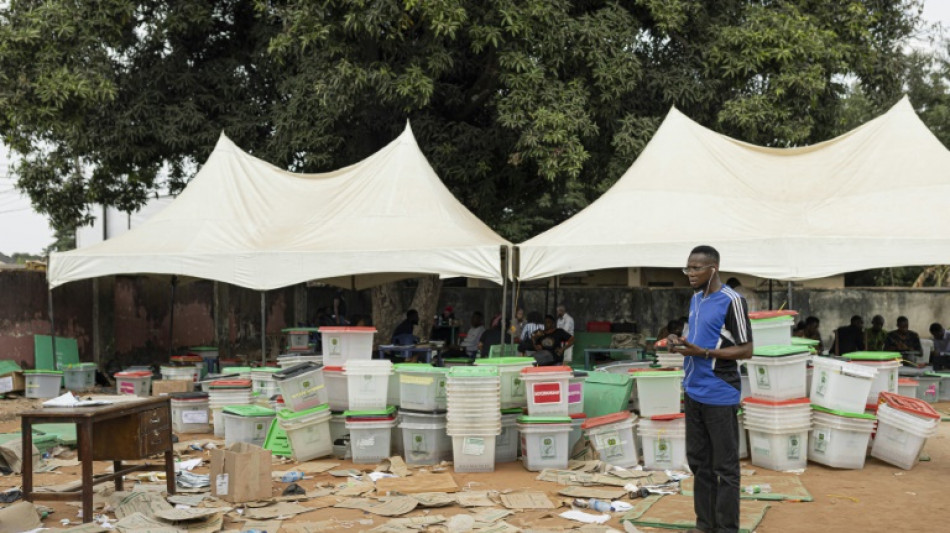
Outsider Obi wins key state Lagos in Nigeria election / Photo: Patrick Meinhardt - AFP
Nigeria's outsider candidate Peter Obi has won the key state of Lagos, according to provisional results on Monday from the tight race for the presidency of Africa's most populous nation.
The Lagos State win by Labour Party's Obi underscored his surprise challenge to ruling All Progressives Congress (APC) and main opposition Peoples Democratic Party (PDP), which have governed Nigeria since the end of military rule in 1999.
Nearly 90 million were eligible to vote on Saturday for a successor to President Muhammadu Buhari, with many hoping a new leader can bring real change to tackle insecurity, economic malaise and widening poverty.
The closely fought race pits Obi against two old-guard rivals, APC's Bola Tinubu, 70, a former Lagos governor, and PDP's Atiku Abubakar, a former vice president on his sixth bid at the presidency.
Voting on Saturday was mostly peaceful, although thugs ransacked some polling stations and many others opened very late. But the slow pace of state by state counting and accusations of manipulation have fuelled tensions.
With more than seven million registered voters, Lagos is one of the key states candidates must win in the presidential race. The megacity is also the bastion of APC's Tinubu, who governed Lagos from 1999 to 2007.
According to provisional results from the local Lagos office of the Independent National Electoral Commission (INEC), Obi won more than 582,000 votes against around 572,000 for Tinubu.
Obi, 61, a former Anambra State governor, has attracted younger voters with a campaign message of change from his two septuagenarian rivals.
Tinubu, 70, known as the "Godfather of Lagos" for his political influence, accepted his Lagos State defeat and urged his supporters to remain calm.
"The fact that the APC narrowly lost Lagos State to another party should not be the reason for violence," he said in a statement. "As a democrat, you win some, you lose some."
- Slow count -
INEC has so far only released official results from four of Nigeria's 36 states and the inal count could take days.
Tinubu had won western Kwara State and southwestern states of Ondo and Ekiti while PDP's Abubakar won Osun state, according to official INEC tallies. It was expected to confirm the Lagos results later Monday.
To win the presidency, a candidate must garner the most votes, but also win at 25 percent of votes cast in two-thirds of Nigeria's 36 states to reflect a country equally split between a mostly Muslim north and widely Christian south as well as three main ethnic groups.
Voting is usually determined by large key states such as Lagos, northwestern Kano and Kaduna.
"Let’s be cautious, it’s not the first time that the APC has lost Lagos in a presidential election. It’s an upset," head of Eurasia Group's Africa practice Amaka Anku told AFP.
Votes for the presidency are tallied by hand at local polling stations and results are uploaded online to INEC's central database IReV, which is meant to improve transparency.
But slow uploading of results to INEC's website has fuelled worries of malpractice in a country with a history of ballot rigging and vote buying.
PDP on Monday accused the ruling APC governors of pressuring INEC over results in the southeast and in parts of Lagos.
"APC is doing all in its means to cheat in Lagos," PDP spokesman Dele Momodu told reporters.
The Labour Party also accused APC of trying to manipulate counting in Lagos and southern Delta state, though the ruling party dismissed those claims.
Nigeria's police force on Monday urged presidential candidates to "caution their party stalwarts and supporters to avoid making inciting comments".
On Monday, dozens of troops were deployed around a large Lagos market area, where police said "hoodlums" had been harassing market owners, an AFP correspondent at the scene said.
- No sabotage -
INEC said on Sunday problems with uploading results were due to "technical hitches" and there was no risk of tampering.
"The commission wishes to assure Nigerians that the challenges are not due to any intrusion or sabotage of our systems," it said.
The vote in Africa's biggest democracy is being closely watched elsewhere in a region battered by coups in Guinea, Burkina Faso and Mali, and growing Islamist militancy.
Tinubu, a southern ethnic Yoruba Muslim, and Abubakar, Muslim from the northeast, are long-time political fixtures who have fought off past corruption accusations. But the emergence of Obi -- a Christian ethnic Igbo from the southeast -- threw the race open.
Some analysts are forecasting a runoff between the two frontrunners if no candidate meets election requirements -- a first in Nigeria's history. It would have to be organised within 21 days.
Whoever replaces him must quickly get to grips with Africa's largest economy and top oil producer, beset by problems including a grinding jihadist war in the northeast and double-digit inflation.
M.Arya--BD