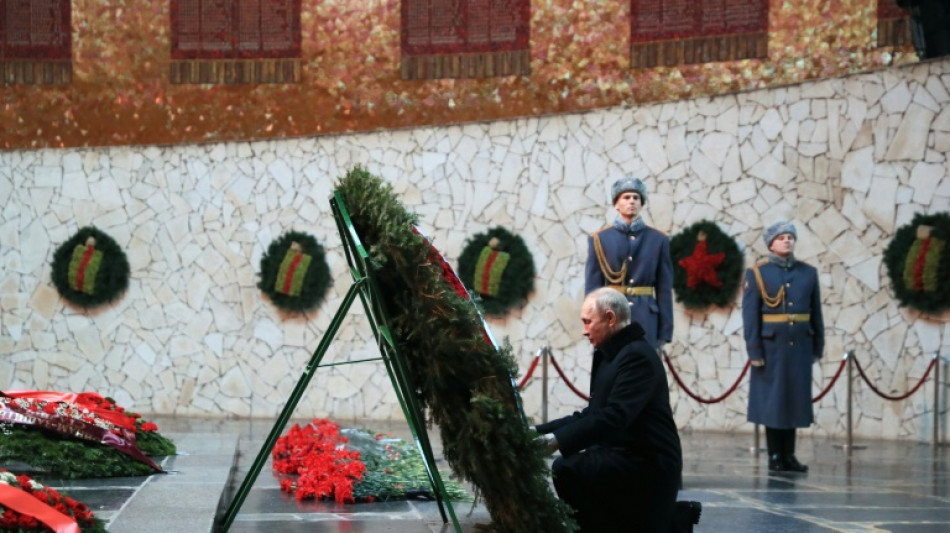
Putin draws parallels between WWII and Ukraine conflict / Photo: Dmitry LOBAKIN - SPUTNIK/AFP
President Vladimir Putin leveraged a World War II commemoration on Thursday to whip up support for his army's intervention in Ukraine, comparing the fighting to Nazi Germany's invasion and hinting Moscow could use nuclear weapons.
Putin has used World War II to promote his political agenda in recent years while the Kremlin has sought to give cult status to Moscow's victory in what Russians call the Great Patriotic War.
Arriving in the southern city of Volgograd for commemorations to mark the 80th anniversary of the Soviet victory at the Battle of Stalingrad, achieved at enormous cost, Putin sought to boost support for his assault on Ukraine.
He compared Russia's so-called "special military operation" in Ukraine to the war against Nazi Germany in 1941-1945 and claimed Russians were ready to go "until the end."
"Again and again we are forced to repel the aggression of the collective West," Putin said in the city on the Volga River formerly known as Stalingrad.
"We aren't sending tanks to their borders but we have something to respond with, and it won't be just about using armoured vehicles. Everyone should understand this," he added.
"A modern war with Russia will be completely different," he said.
Since sending troops to pro-Western Ukraine last February Putin has repeatedly threatened to use nuclear weapons against the West if the conflict escalates.
"It's unbelievable but true. We are again being threatened by German Leopard tanks."
- 'To go until the end' -
"Readiness to go until the end, to do the impossible for the sake of the motherland, for the sake of truth was -- and is -- in the blood, in the character of our multinational people," said Putin.
He spoke after laying flowers at the city's legendary landmark -- a hilltop memorial to the battle that includes the towering 85-metre (279-foot) sculpture of a woman with a raised sword known as "The Motherland Calls".
The commemorations in the southern Russian city come as the Kremlin looks to step up its offensive in Ukraine, bolstered by tens of thousands of reservists mobilised last autumn.
The 1942-43 Battle of Stalingrad raged for nearly six months and when it was over the city was in ruins and more than a million soldiers and civilians had lost their lives.
The Red Army's victory marked a turning point not only for the Soviet Union, which had suffered several heavy defeats, but also for the Allied forces.
Russia has claimed recent gains near the hotspot town of Bakhmut in the eastern Donetsk region of Ukraine.
Moscow recently announced the capture of the eastern town of Soledar as it seeks to wrest control of the entirety of the region of Donetsk -- a region it claims to have annexed.
Although the significance of capturing the salt-mining town is disputed, Soledar was the first major victory for Russia's forces following a series of setbacks on the ground.
- Bust of Stalin -
On the eve of Putin's arrival, a bust of dictator Joseph Stalin was unveiled in Volgograd.
Since Putin took power in Russia in 2000, a growing chorus of Russians are taking a positive view of the despot's role in history, and analysts have pointed to the creeping rehabilitation of Stalin in the country.
Nostalgic for the superpower status of the USSR, many Russian officials have been promoting Stalin as a tough leader who led the Soviet Union to victory in World War II and presided over the country's industrialisation.
The Soviet Union lost an estimated 20 million people in World War II and the legacy of what is known in the country as the Great Patriotic War is venerated.
The city was renamed Volgograd in 1961, eight years after the death of Stalin.
Since 2013, the city is temporarily renamed Stalingrad several times a year, including on February 2 and on May 9, when Russia holds nationwide celebrations on the anniversary of the Soviet victory in World War II.
E.Narula--BD