Russian prosthetics workshops fill up with wounded soldiers / Photo: Olga MALTSEVA - AFP
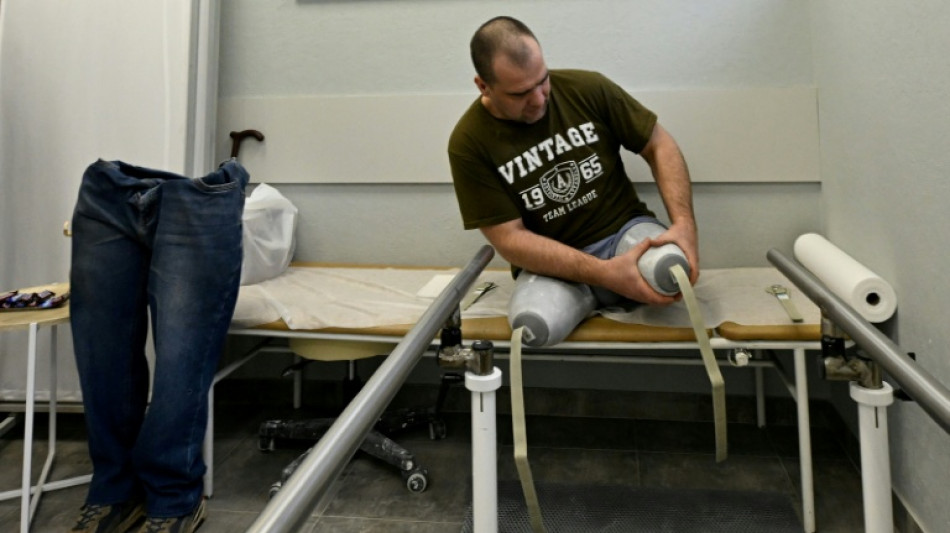
After losing his right leg on the battlefield in Ukraine, Dmitry, a former fighter with Russia's Wagner paramilitary group, is walking again thanks to a new prosthetic limb.
With hundreds of thousands of soldiers coming back from the front wounded, Russia's prosthetics workshops -- like the one outside Saint Petersburg where AFP met Dmitry -- have been filling up with ex-fighters.
Dmitry, 54, had already fought in Syria and for Moscow-backed separatists in Ukraine's eastern Donbas region before Russia launched its full-scale offensive in February 2022.
He recalled his injury with a faint smile.
His unit was bombed as it tried to cross the Dnipro river.
The next moment, he saw his right leg lying next to him. Torn off.
"It was my first injury," said Dmitry, who declined to give his last name and goes by the call sign "Barmak".
"I was surprised that I fought so long and was constantly lucky."
He also suffered a serious abdominal injury, spending eight months in hospital and a year in a wheelchair.
"The atmosphere is friendly here, almost soothing," he said of the private prosthetics workshop in Vsevolozhsk, outside Russia's second-largest city.
In the small studio, workers in ventilation masks were measuring, buffing and painting artificial limbs as Dmitry had his fitting inspected.
- Hefty payments -
Russia does not say how many of its soldiers have been killed or wounded in Ukraine -- but independent reporting and Western intelligence estimates put it in the several hundreds of thousands.
Government data shows Moscow issued 60,000 more prosthetic limbs in 2024 than in 2021, the last full year before the war -- a 65-percent increase.
Even if they don't disclose how they lost a limb, workshop head Mikhail Moskovtsev told AFP it was "obvious" who the ex-soldiers were among his clients.
"These are specific wounds, for example from mine blasts" -- easily distinguishable from the victims of car accidents and extreme sports enthusiasts.
Moskovtsev does not ask questions.
"For me everyone is equal," he said. "I don't ask the person where it's from or the reasons behind it. If they want, they talk on their own."
His workshop employs around a dozen people.
State-of-the-art prostheses can cost up to five million rubles ($65,000).
Russian veterans can choose between public and private facilities, and are offered a host of rehabilitation programmes and cash pay-outs depending on the severity of their wounds.
Dmitry got three million rubles.
"I bought my car with it," he said, adjusting his prosthetic leg as he climbed into a new black pick-up truck outside the centre.
A seasoned soldier, he told AFP he was impressed by the support Moscow offered wounded veterans -- contrasting it with a sense of abandonment after the Soviet Union's war in Afghanistan or the Chechen campaigns of the 1990s and early 2000s.
"I remember very well the return of the veterans of Afghanistan and the famous phrase from the bureaucrats: 'I'm not the one who sent you there'.
"It was the same with the soldiers of the first and second Chechen wars," he said.
- 'New elite' -
The support is just one way Russia has overhauled its economy and geared its entire society to support the offensive on Ukraine.
Lucrative salaries lure men to fight, while President Vladimir Putin wants veterans to take leadership roles, fill up the bureaucracy and form the country's "new elite".
Still there are concerns about social problems linked to the thousands of men coming back from the front.
At the workshop near Saint Petersburg was another ex-soldier, also called Dmitry, also with a missing leg.
A drone struck the vehicle he was in while fighting in the Ukrainian city of Bakhmut in 2024.
Asked about why he went to fight, the 42-year-old, known as "Torg" on the battlefield, echoed Kremlin talking points -- widely debunked and rejected by Ukraine and NATO -- about protecting Russia.
"My main motivation was to make sure that what was happening there stayed there, so that the conflict did not spread to our territory," he said.
He now sports a jet black prosthetic leg with blood-red curves painted around it.
Both Dmitrys said they had no regrets.
Despite his condition, father-of-two "Torg" said his view on the war had not changed.
"I would do the same again," he said, without hesitation.
P.Raval--BD