Crude tumbles, stocks rally on hopes for Iran war de-escalation / Photo: Jim WATSON - AFP
Oil prices tumbled and stocks rose Wednesday on hopes for a de-escalation of the Middle East war after Washington sent a peace plan to Iran, while Tehran announced it will let "non-hostile" oil vessels through the crucial Strait of Hormuz.
After nearly four weeks of conflict, investors jumped on the first signs that hostilities could wind down, though analysts pointed out that the arrival of more US troops in the region suggested the chance of escalation remained.
The economic impact of the crisis has begun to bite around the world, with governments looking to cut energy consumption and airlines scaling back flights.
Both main crude contracts plunged more than six percent -- with Brent back below $100 -- after US President Donald Trump voiced optimism at ending the war and said officials were "in negotiations right now". Iran has not confirmed any formal talks.
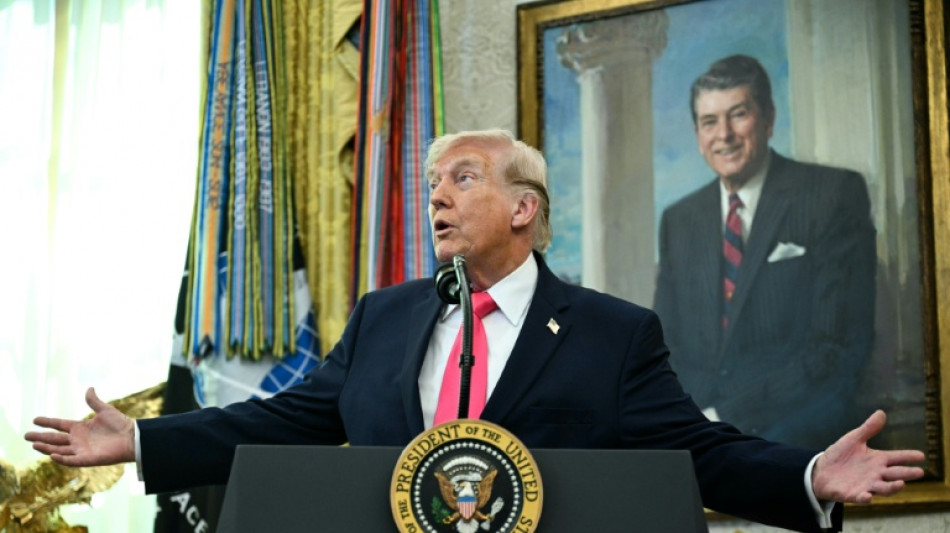
"They did something yesterday that was amazing actually. They gave us a present and the present arrived today. And it was a very big present worth a tremendous amount of money," Trump told reporters in the Oval Office.
"That meant one thing to me -- we're dealing with the right people."
He did not explain further but said it related to the Strait of Hormuz, through which a fifth of global oil and gas flows and which Iran has largely blockaded, sending global energy prices soaring and fuelling fears of another surge in inflation.
Trump said that he sent a plan and that it "all starts with, they cannot have a nuclear weapon", while the New York Times quoted unnamed officials saying the 15-point proposal was sent through Pakistan.
Israel's Channel 12 said that Trump was suggesting a one-month ceasefire during which they would discuss handing over Iran's enriched uranium and banning further enrichment, while Tehran would also ensure safe passage through the Strait of Hormuz.
The Israeli report also said Iran would see an end to all sanctions and receive assistance in developing civil nuclear energy.
- Economic impact -
Meanwhile, Tehran, in a message circulated by the International Maritime Organization, assured safe passage through the strait to "non-hostile vessels".
Iran had already said it was not targeting friendly nations.
The news comes after Trump on Saturday gave Iran 48 hours to open Hormuz or he would strike the country's energy infrastructure, before making a surprise U-turn Monday, citing "very good" talks.
Equity traders pounced on the developments, with Tokyo and Seoul spiking more than three percent at one point, while Hong Kong, Sydney, Shanghai, Singapore, Wellington and Taipei also rallied.
However, violence continued, with an Iranian missile wounding people in Israel, which in turn pressed on multiple fronts and vowed to seize control of a strip of southern Lebanon.
"Markets have tentatively repriced towards a slightly higher probability of de-escalation, but conviction remains low," said Pepperstone's Chris Weston.
However, he added that "developments on the ground do not fully support a de-escalation narrative".
"Reports that the 82nd Airborne Division could deploy around 3,000 troops to the Middle East, alongside discussions around raising the US enlistment age from 34 to 42, point to continued preparation and an increased presence in the region, which in Trump's thinking could increase the pressure on Iran to forge an agreement in the reported upcoming talks."
The economic impact is becoming increasingly clearer.
Data Tuesday showed business activity in the eurozone slowed significantly in March as energy prices surged and global supply chains were hit, while France's INSEE statistics agency trimmed its growth forecast for the first and second quarters of this year.
Philippine President Ferdinand Marcos declared a state of "national energy emergency", citing risks to domestic supplies, and Sri Lanka ordered street lights, neon signs and billboard lighting to be switched off.
Bangladesh raised jet fuel prices 79 percent and Ireland slashed the excise duty on petrol and diesel to stem surging prices at filling stations.
And major airlines Lufthansa, Cathay Pacific and Air France extended flight suspensions to destinations across the Middle East.
- Key figures at around 0210 GMT -
West Texas Intermediate: DOWN 5.2 percent at $87.52 a barrel
Brent North Sea Crude: DOWN 6.3 percent at $97.90 a barrel
Tokyo - Nikkei 225: UP 2.7 percent at 53,664.86
Hong Kong - Hang Seng Index: UP 1.0 percent at 25,321.32
Shanghai - Composite: UP 0.9 percent at 3,916.28
Euro/dollar: UP at $1.1611 from $1.1583 on Tuesday
Pound/dollar: UP at $1.3414 from $1.3381
Dollar/yen: DOWN at 158.70 yen from 159.03 yen
Euro/pound: DOWN at 86.55 pence from 86.57 pence
New York - Dow: DOWN 0.2 percent at 46,124.06 (close)
London - FTSE 100: UP 0.7 percent at 9,965.16 (close)
A.Krishnamurthy--BD