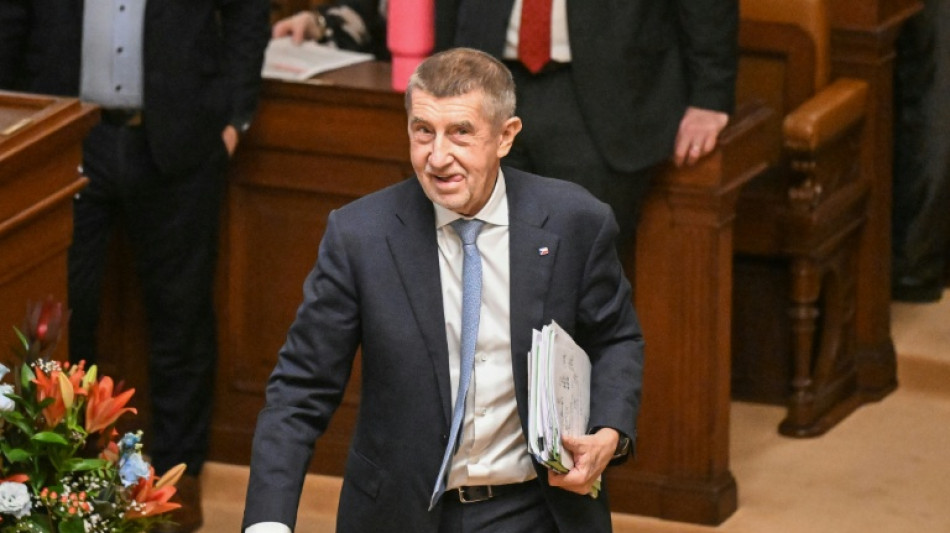
Businessman or politician? Billionaire Czech PM under fire again / Photo: Michal Cizek - AFP
Since entering politics in 2011, Czech Prime Minister Andrej Babis has been grappling with a conflict of interest as a billionaire businessman and politician, and his latest stint in power is no exception.
Babis, a Donald Trump fan who has been back in office since December, insists he obeyed Czech law when he transferred his Agrofert food and chemicals group to the RSVP Trust fund run by an independent administrator last month.
But the European Commission, the anti-corruption watchdog Transparency International and media at home and abroad are scratching their heads.
"The RSVP Trust statutes confirm that Prime Minister Babis has not resolved his conflict of interest," said David Kotora, heading Transparency International's Czech branch.
"The Czech law is so vague that he may pass... but we are convinced that he will fail to comply at the European level," he told AFP.
A European Commission notice from 2021 defines a conflict of interest as a situation wherein a "financial actor's" impartiality is compromised "for reasons involving... economic interest or any other direct or indirect personal interest".
Besides having a say on the Czech budget, Babis attends European Council talks on the EU budget as premier.
Agrofert said it received the equivalent of $80 million in Czech and EU subsidies in 2024, and $103.5 million in 2023.
Before taking office, Babis vowed to "irreversibly" transfer Agrofert to RSVP Trust, saying his children will inherit the holding after his death.
"I have no influence on Agrofert and I have and will not have any profits from it," said Babis, the seventh wealthiest Czech worth $4.6 billion according to Forbes magazine.
But the RSVP Trust statutes recently published by the Seznam Zpravy news site say the independent administrator will only run the fund while Babis is a government member.
When he quits, the management will be passed onto three of Babis's four children, who could theoretically put Babis back in charge.
- 'Complicated' -
Under the statutes, the fund will manage Agrofert and then pass it on to Babis's offspring "in order to ensure the long-term fulfilment of their material needs".
Bohumil Havel, a business law expert from Prague's Charles University, said the statutes were "complicated" and enabled "multiple interpretations".
He told AFP Babis most probably complied with the Czech conflict of interest law, dubbed "lex Babis".
"However, there is the general rule... that each government member must avoid a conflicting behaviour benefiting for instance their relatives," Havel added.
Kotora also said Babis would be interested in "passing the assets on to his children".
"He said it was irreversible and that he will never get Agrofert back. Which is not true because the fund enables that," he added.
Transparency International has also slammed Babis for keeping other businesses including the chemicals and investment group SynBiol.
Babis, who calls Transparency International "a corrupt NGO", blames local political opponents for stoking the problem.
"They have made up this conflict of interest. And they are only trying to harm me, to get me out of politics," he told AFP recently.
- Deja-vu -
It is a deja-vu for Babis who transferred Agrofert to two trust funds when he first served as premier from 2017 to 2021, but publicly available documents showed he was still its beneficial owner.
The Czech finance ministry stopped asking the EU for subsidy payments for Agrofert following an EU audit.
The group only had to return some domestic subsidies, including $5 million for Babis's bakery equipment.
The European Commission inquired about the current allegations in a letter on February 19.
"The answer is being drafted and we cannot anticipate... We will respond to all questions asked by the European Commission," regional development ministry spokeswoman Veronika Lukasova told AFP.
For Kotora, the letter from Brussels is a good sign.
"The premier said nobody in the EU administration was interested. So this has been refuted," he said.
Earlier this month, the Czech parliament declined to strip Babis of immunity to face trial over EU subsidy fraud worth $2.5 million from 2007.
Babis is charged with taking a farm out of Agrofert to make it eligible for a subsidy for small companies -- a case he calls "clearly politically motivated".
G.Vaidya--BD