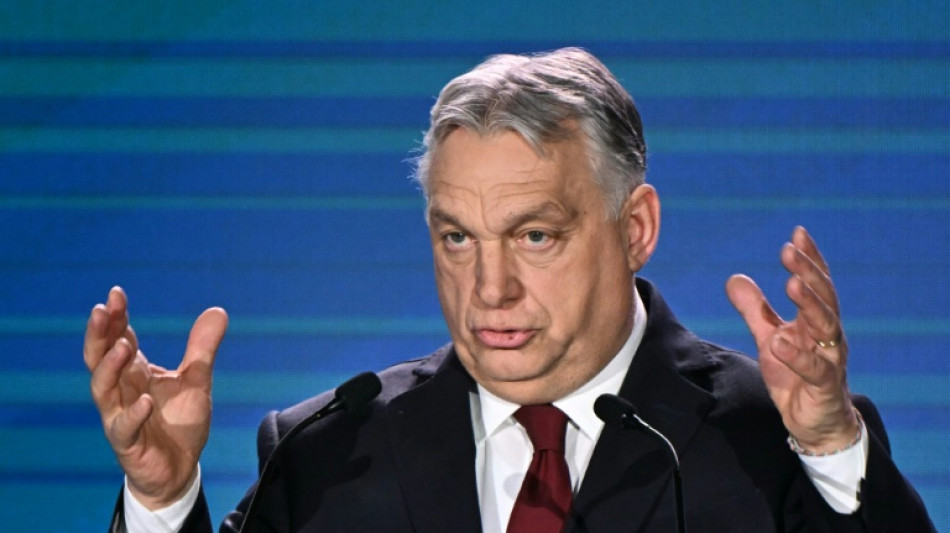
Hungary to expel seven Ukrainians as Zelensky, Orban quarrel over Russian oil / Photo: Attila KISBENEDEK - AFP
Hungary will expel seven detained Ukrainians, the government said Friday, as Hungarian Prime Minister Viktor Orban and Ukrainian President Volodymyr Zelensky traded threats in a row over stalled Russian oil supplies.
Kyiv accused Budapest of kidnapping seven of its citizens on Friday, as Orban said he would use "every means" to pressure Ukraine over the Russian oil.
A day earlier, Zelensky appeared to have issued a direct threat against Orban, saying Ukraine's armed forces would "talk to him in their own language".
Hungary and Slovakia say Ukraine is deliberately delaying reopening a key pipeline pumping Russian oil to the two landlocked EU member states, which Kyiv says was damaged by Russian strikes in January.
- Travel warning -
Early Friday, Ukraine's Foreign Minister Andriy Sybiga accused Hungary of taking "hostage" a group of Ukrainian bank employees who were transporting $40 million, 35 million euros and nine kilogrammes of gold through the country.
Hungary's National Tax and Customs Administration said it detained seven Ukrainian citizens, including a former Ukrainian secret service general, and two armoured cash transport vehicles on Thursday.
NAV "is conducting criminal proceedings on suspicion of money laundering", it said in a statement, adding the investigation was done in cooperation with the Counter-Terrorism Centre.
Government spokesman Zoltan Kovacs said those detained would be expelled.
"Authorities found the operation was supervised by a former general of the Ukrainian Security Service, with a former major of the Ukrainian Air Force acting as deputy and assisted by individuals with military experience," he said on X.
"Based on these findings, all seven individuals will be expelled from Hungary," he added.
Ukraine on Friday urged its citizens to avoid travel to Hungary, citing "the inability to guarantee their safety amid the arbitrary actions of the Hungarian authorities".
In a radio interview earlier Friday, Orban said until the oil delivery issue is resolved, Hungary "will use every step and every means at our disposal", including stopping "things passing through Hungary, things that are important to Ukraine".
Relations between the two neighbours have already been strained by Orban's sustaining ties with Russia despite Moscow's invasion of Ukraine, and his opposition to military aid for Kyiv.
But ties deteriorated further after the Hungarian premier ramped up political attacks on Ukraine ahead of a closely fought parliamentary election on April 12.
Orban has been stalling a 90-billion-euro ($106 billion) EU loan to the war-torn country and a new round of sanctions on Russia, disputing the damages to the Druzhba pipeline and demanding that Kyiv reopen it first.
Zelensky said the pipeline can only be made operational after another four to six weeks, although he would personally prefer not to restore transit.
"We hope that one person in the European Union will not block the 90 billion (euros)... Otherwise we will give this person's address to our Armed Forces, to our guys. Let them call him and talk to him in their own language," Zelensky said.
The statement was condemned by Hungary's government and its opposition as well.
In his state radio interview, Orban said he would not give in, "not even if they blackmail me, not even if they threaten my life".
- 'Demand explanations' -
The State Savings Bank of Ukraine, or Oschadbank, said that the bank staff were transporting the cash and gold between Raiffeisen Bank Austria and Oschadbank Ukraine in two vehicles on Thursday.
A Raiffeisen spokesman told AFP the company is not "affected by the incident", declining to comment further.
The Oschadbank cash-in-transit vehicles that were seized on Thursday have been placed in a "restricted area of the Hungarian Counterterrorism Centre", a source with knowledge of the matter told a group of journalists including AFP.
Ukraine's central bank said it would sent a team to Budapest "to clarify circumstances".
"And we're appealing to international partners and regulators. We demand official explanations from Hungarian authorities," Ukraine central bank governor Andriy Pishnyy said on X.
burs-ros-jza/st
G.Luthra--BD