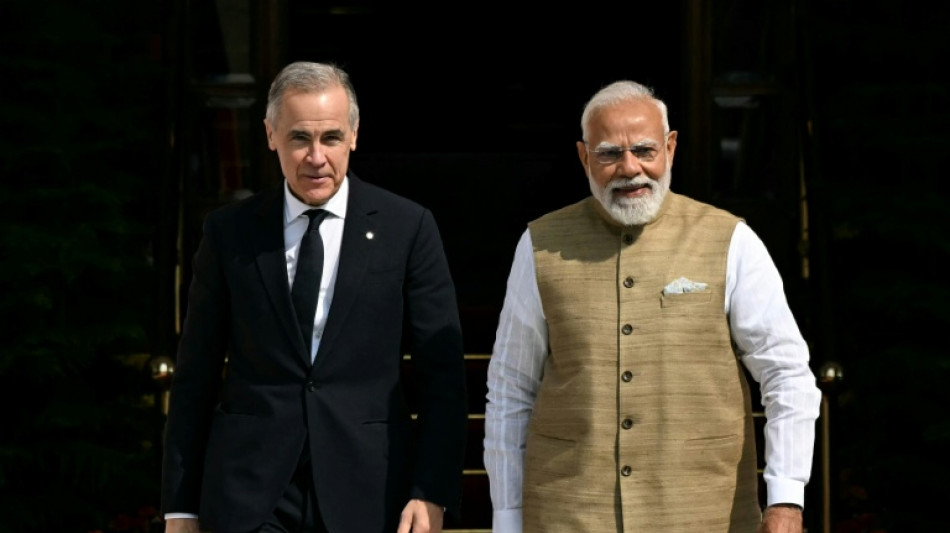
Canada and India strike agreements on rare earth, uranium / Photo: Sajjad HUSSAIN - AFP
India and Canada on Monday reached a string of agreements, including on critical mineral cooperation and a "landmark" uranium supply deal for nuclear power, the countries' leaders said in New Delhi.
The pacts, which also covered technology and promoting the use of renewable energy, were announced after Prime Minister Narendra Modi and his Canadian counterpart Mark Carney hailed a fresh start in the relationship between their nations.
"Our ties have seen a new energy, mutual trust, and positivity," Modi said.
Ties effectively collapsed in 2023 after Ottawa accused New Delhi of orchestrating a deadly campaign against Sikh activists in Canada, accusations India rejected.
Carney's visit -- his first to India since taking office last year -- is not only aimed to reset strained ties, but also to push efforts to diversify trade beyond the United States.
"There has been more engagement between the Canadian and Indian governments in the last year than there has been in more than two decades combined," Carney said in New Delhi, in a speech alongside Modi.
"This is not merely the renewal of a relationship. It is the expansion of a valued partnership with new ambition, focus, and foresight, a partnership between two confident countries charting our own course for the future."
- 'New opportunities' -
Energy-hungry India -- the world's most populous country with 1.4 billion people -- has ambitious plans to expand nuclear power capacity from its current eight to 100 gigawatts by 2047.
"In civil nuclear energy, we have struck a landmark deal for long-term uranium supply," Modi said, adding the countries would also work together on small modular reactors and advanced reactors.
Carney said they had agreed the launch of a "strategic energy partnership with significant potential" including CAN$2.6 billion ($1.9 billion) uranium supply agreement "supporting India's nuclear ambitions".
Carney added that Canada was "well positioned to contribute, as a reliable supplier" of liquefied natural gas (LNG), from its west coast.
"As India seeks access to critical minerals for its manufacturing, its clean-tech, and its nuclear plants, Canada's resource base and world-leading companies position it as a strategic partner," he said.
The two countries agreed last year to resume negotiations on a proposed free-trade deal, the Comprehensive Economic Partnership Agreement.
"Our target is to reach $50 billion in bilateral trade," Modi said. "This is why we have decided to finalise a comprehensive economic partnership soon," he added, saying it "will open new opportunities to invest and create jobs in both countries".
- Defence deal -
Carney said he wanted to reach a deal on the "ambitious agreement" by the end of the year to "reduce barriers and increase certainty", also said the nations were renewing security cooperation through a "new defence partnership".
Canadian pension and wealth funds have already invested $73 billion in India.
Before Carney took office last year, Ottawa accused Modi's government of direct involvement in the 2023 killing of Hardeep Singh Nijjar, a naturalised Canadian citizen who was part of a fringe group that advocated for an independent Sikh state called Khalistan.
Khalistan militants have been blamed for the assassination of an Indian prime minister and the bombing of a passenger jet.
India has repeatedly dismissed the Canadian allegations, which sent relations into freefall, with both nations expelling a string of top diplomats in 2024.
Ties improved after Carney took office in March 2025, and envoys have since been restored.
After India, Carney will travel to Australia and Japan -- part of a wider push to broaden Canada's economic partnerships.
Carney has made reducing Canada's heavy reliance on the US economy a centrepiece of his foreign economic policy.
In 2024, before US President Donald Trump returned to office and upended global trade with a flurry of tariffs, more than 75 percent of Canadian exports went to the United States. Two-way trade that year exceeded $900 billion.
So far Trump has broadly adhered to the North American free-trade agreement he signed during his first term, and about 85 percent of US-Canada trade remains tariff-free.
But at the same time, Trump has also imposed painful industry-specific tariffs, and there are fears that if he scraps the broader trade deal, the Canadian economy will be hit hard.
burs-pjm/mtp
M.T.Johanson--BD