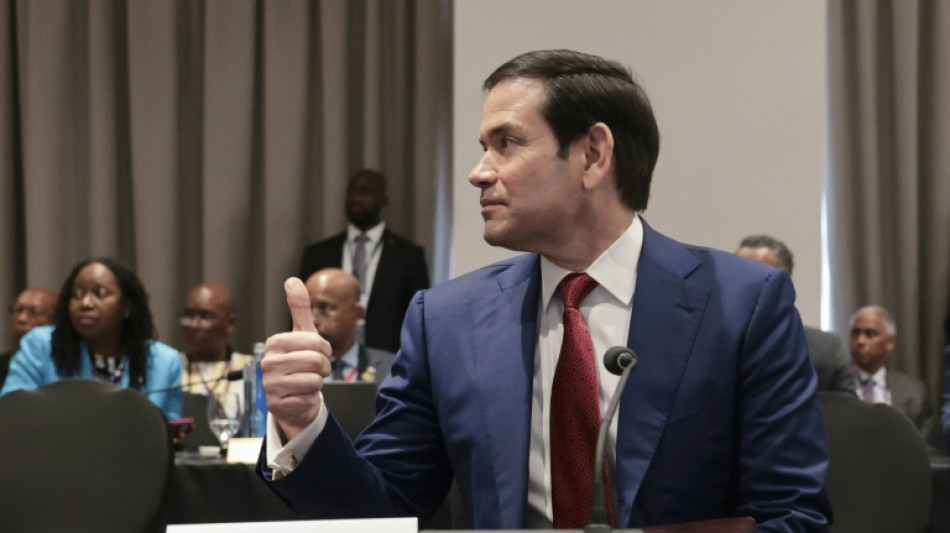
US eases Cuba oil embargo but demands 'dramatic' change / Photo: Jonathan Ernst - POOL/AFP
The United States on Wednesday eased an oil embargo on Cuba but Secretary of State Marco Rubio said the communist-run island must change "dramatically," saying it had only itself to blame for an economic crisis.
Rubio, a Cuban-American and lifelong critic of Havana's government, heard concerns that the island's economic tumult could destabilize the whole region as he attended a Caribbean Community summit.
Attending the talks on the tiny island nation of Saint Kitts and Nevis, Rubio staunchly defended the January 3 US attack that deposed Venezuela's leftist leader Nicolas Maduro.
The United States swiftly then blocked Venezuela from exporting oil to Cuba, which had relied on its ally for nearly half its needs, triggering fuel shortages and rolling blackouts on the island.
The Treasury Department announced Wednesday that the United States would allow Venezuelan oil exports to Cuba's private sector for both commercial and humanitarian use.
Rubio warned that the sanctions would be snapped back if the oil winds up going to the government or military, which dominate the communist nation's economy.
"But Cuba needs to change. It needs to change dramatically because it is the only chance that it has to improve the quality of life for its people," Rubio told reporters.
It is "a system that's in collapse, and they need to make dramatic reforms," he said.
"If they want to make those dramatic reforms that open the space for both economic and eventually political freedom for the people of Cuba, obviously the United States would love to see that would be helpful," he said.
Rubio described the crisis in Cuba as potentially worse than at any point since Fidel Castro's 1959 revolution, but said that the authorities only had themselves to blame.
"They're the ones that have made decisions," he said.
- Warnings of instability -
Rubio spoke as Cuba announced that it had killed four people on a speedboat registered in Florida.
Rubio said that the United States was still studying the "unusual" incident and would respond but said he had little verified information.
Caribbean leaders warned that any further deterioration in Cuba would impact the region and trigger migration -- President Donald Trump's top political concern.
"Humanitarian suffering serves no one," Jamaican Prime Minister Andrew Holness said. "A prolonged crisis in Cuba will not remain confined to Cuba."
Canada, which has long broken with its southern neighbor by maintaining warm relations with Havana, announced Can$8 million ($5.8 million) in aid for Cuba, which has experienced rolling blackouts and acute fuel shortages.
The Caribbean summit's host, Saint Kitts and Nevis Prime Minister Terrance Drew, studied in Cuba to be a doctor and said friends have told him of food scarcity and garbage strewn in the streets.
"A destabilized Cuba will destabilize all of us," Drew said.
- 'Without apology' on Venezuela -
Addressing the summit, Rubio staunchly defended the deadly operation that seized Maduro, saying that Venezuela has made "substantial" progress since then.
"I will tell you this without any apology or without any apprehension: Venezuela is better off today than it was eight weeks ago," Rubio said.
Rubio said he believed Venezuela had moved to a new phase and that there was a need for "fair, democratic elections," although he did not lay out a timetable.
The United States once championed Venezuela's democratic opposition but since removing Maduro it has worked with interim president Delcy Rodriguez, who was Maduro's deputy.
Trump has voiced satisfaction with Rodriguez, including her welcome to US oil companies, and has threatened her with violence if she does not do his bidding.
Rubio separately met at the summit with beleaguered Haiti's prime minister, Alix Didier Fils-Aime.
A transitional council set up nearly two years ago handed power to Fils-Aime this month with US support, after it failed to tackle rampant gang violence or hold elections.
Rubio is the highest-ranking sitting US official ever to visit Saint Kitts and Nevis, a tiny former British colony reliant on beach tourism that was the birthplace of a US founding father, Alexander Hamilton.
W.Atwal--BD