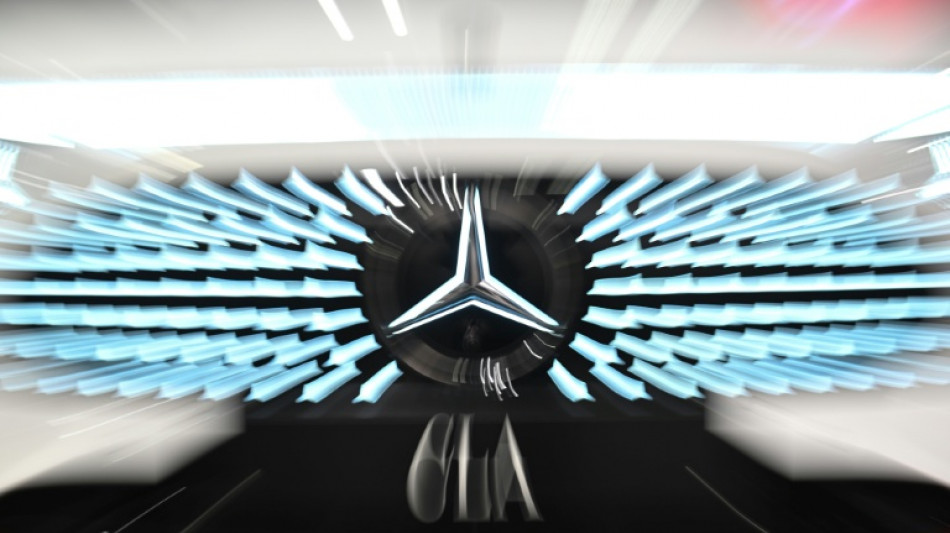
Mercedes-Benz net profit nearly halves amid China, US woes / Photo: THOMAS KIENZLE - AFP
German carmaker Mercedes-Benz reported Thursday its lowest annual profit since the Covid pandemic, as it counted the cost of US tariffs and cutthroat competition in China.
Net profit for 2025 was 5.3 billion euros ($6.3 billion), Mercedes said, down almost 49 percent from 2024 but better than had been expected in a poll of analysts by financial data firm FactSet.
"Amid a dynamic market environment, our financial results remained within our guidance," chief executive Ola Kaellenius said, adding that he saw hope in over 40 new model launches planned for the next three years.
"We are moving forward with a clear game plan and a very competitive product portfolio," he said.
The firm expects a similarly difficult 2026, however, with revenue projected to be around last year's level of 132.2 billion euros.
Its core profit should be "significantly above" the 2025 figure thanks to an absence of one-off restructuring charges.
But at its core car business, Mercedes sees a profit margin this year of three to five percent -- potentially weaker than the five percent it achieved last year.
Mercedes-Benz shares opened down 4.5 percent in Frankfurt but later recovered a bit, trading down 2.6 percent at midday, making it one of the worst performers in Germany's blue-chip DAX index.
- 'Once-in-a-hundred years transformation' -
A storied company that traces its history back to Carl Benz inventing the first motor car in 1885, Mercedes last year took a hit from US President Donald Trump putting tariffs on foreign carmakers.
Speaking on the earnings call, chief financial officer Harald Wilhelm said the duties introduced partway through last year had cost the company about 1 billion euros.
"It's really a lot of money," he said. "It's going to go up in 2026 because we'll have a full-year impact -- It's going to be a significant number."
The duties came as the company was facing a triple whammy of cratering sales in China, stagnant demand in Europe and the costs of investing into electric cars despite patchy demand.
"The auto industry and our company, we're in a once-in-a-hundred years transformation," Kaellenius said on the call.
"It's happening in an environment that is more dynamic than we have experienced in many, many years."
China, the world's biggest car market, has become a battleground for German carmakers amid a brutal price war and fierce competition from local players like BYD and Geely.
Mercedes-Benz's sales by volume in China plunged 19 percent last year to their lowest level since 2016, helping drag overall worldwide sales down by 10 percent.
Wilhelm said that Mercedes-Benz expected to lose further sales in China despite new launches, and that difficulties in the market could further weigh on results.
"China is always, I think, unforeseeable in terms of the intensity of the competitive environment," he said. "It could be an element which could bring us even further down."
R.Prakash--BD