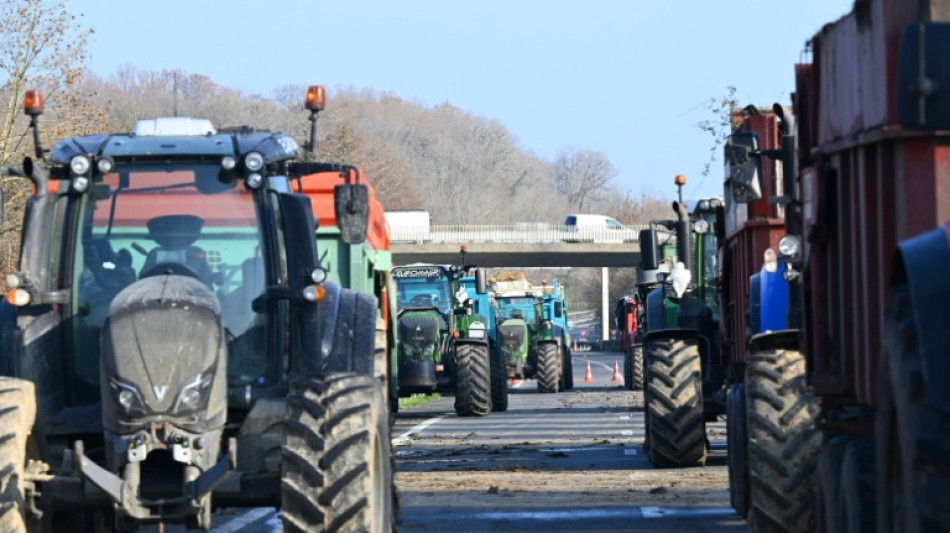
'Stop the slaughter': French farmers block roads over cow disease cull / Photo: Gaizka IROZ - AFP
Farmers in southwestern France blocked roads and set fire to bales of hay Saturday to protest the culling of cows due to a skin disease, as the government said one million cattle would be vaccinated.
French farmers have been angry over what they see as the government's heavy-handed response to an outbreak of nodular dermatitis, widely known as lumpy skin disease.
On Friday, veterinarians slaughtered a herd of more than 200 cows in the village of Les Bordes-sur-Arize near the Spanish border after discovering a single case of the sickness. Police had to disperse angry farmers as they escorted in a team to carry out the culling.
Several unions have said that slaughtering whole herds is ineffective, calling for blockades across France "to put an end to this madness".
On Saturday, dozens of tractors blocked traffic, while others parked in front of public buildings, as farmers set fire to bales of straw and tyres.
Nearly 150 kilometres of the A64 motorway between Bayonne and Tarbes were closed to traffic due to blockades that began late Friday.
Lumpy skin disease, which cannot be passed to humans but can be fatal for cattle, first appeared in France in June.
- 'Lifetime of work' -
The official strategy to stamp out what the authorities describe as a very contagious disease has been to slaughter all animals in affected herds, and carry out "emergency vaccination" of all cattle within a 50-kilometre (30-mile) radius.
"It's the extermination of cows and farmers," said Leon Thierry of hard-line farmers' union Coordination Rurale (CR), who protested in the town of Briscous with more than a dozen farmers and around 40 tractors.
"It is out of the question that in the Pyrenees we should slaughter animals that are not sick, that are healthy, because they belong to a herd from which, supposedly, a sick animal has emerged," he said.
Around a hundred farmers gathered in Carbonne located some 40 kilometres southwest of Toulouse, setting up camp on the A64 highway.
"They deploy riot police to kill 200 cows, but you don't see them at the drug-dealing spots!" said Benjamin Kalanquin, 24, who works not far from the farm where the entire herd was slaughtered.
"Total slaughter is not the solution," he said, vowing to camp on the motorway until Christmas "if there is no convincing response".
"People are fed up," added Benjamin Roquebert, 37.
"You can't build up a herd in five minutes," added the cattle breeder and grain producer. "It's a lifetime of work, spanning several generations."
The protesters also say the government is not doing enough to protect them.
The European Union next week expected to sign on to a trade deal with South America that farmers say will flood the market with cheap agricultural products that will outcompete them.
"We're struggling, we can't eat, we can't even make 1,000 euros a month," said another protester, Aurelien Marti.
- Vaccination -
Around 70 farmers sounded their horns and set off firecrackers and smoke bombs in front of the agriculture minister's former parliamentary office in the eastern town of Pontarlier. They hung a dead calf from a tree with a sign saying "Our Animals, Our Life."
Agriculture Minister Annie Genevard said on Saturday the government planned to vaccinate one million head of cattle in the Nouvelle-Aquitaine and Occitanie regions.
"In the coming weeks, we will vaccinate nearly one million animals, thereby protecting farmers," she told Ici Occitanie radio.
Those vaccinations would be in addition to the million head of cattle already vaccinated since July, the agriculture ministry told AFP.
The culls have divided farmers' unions.
The leading FNSEA farming union supports the total culling of affected herds.
burs/as/jj
V.Upadhyay--BD