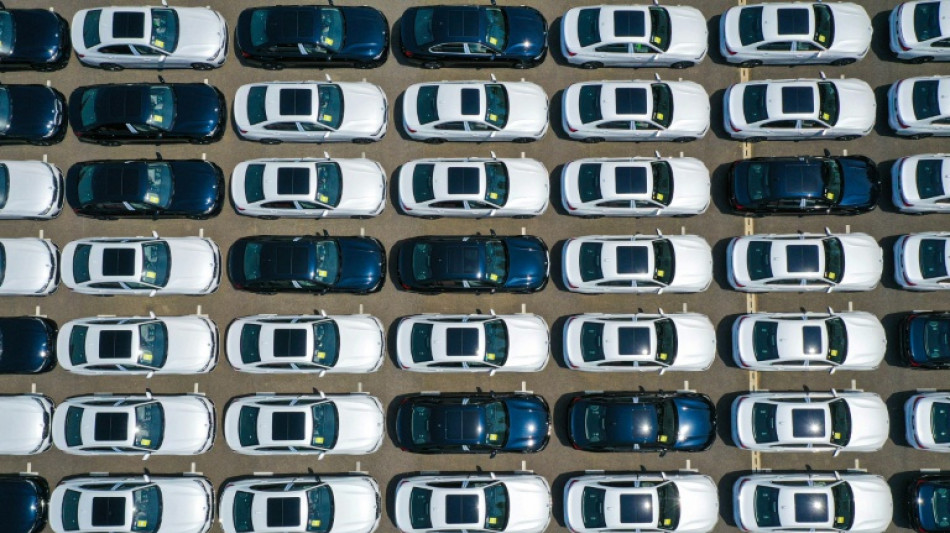
EU agrees recycled plastic targets for cars / Photo: STR - AFP/File
Car manufacturers in Europe will have to include more recycled plastics in new vehicles under new EU rules agreed on by the bloc's countries and lawmakers on Friday.
European Union governments and parliament representatives reached an early morning deal to mandate that at least 25 percent of plastics used in cars, trucks and motorcycles has been recycled.
Carmakers will have to meet the mandatory target in 10 years, with an intermediate 15 percent goal in six years, according to the European Council representing member states.
At least 20 percent of the recycled materials will have to be sourced from old, scrap vehicles.
"This provisional agreement marks a significant step towards a circular economy for the European automotive sector," said Magnus Heunicke, environment minister for Denmark, which holds the EU's rotating presidency.
Vehicle manufacturing accounts for 10 percent of the EU's overall consumption of plastics, and is responsible for 19 percent of demand for the bloc's steel industry, according to Brussels.
The deal is provisional and needs to be officially endorsed by the European Council representing member states and the parliament before it is formally adopted.
It also instructs the European Commission to set future targets for recycled steel, aluminium, magnesium and critical raw materials and bans the export of old vehicles that are no longer roadworthy.
Around 3.5 million vehicles "disappear without trace from EU roads" every year and are exported, dismantled or disposed of illegally, according to the council.
The commission had initially proposed a much speedier implementation of the targets -- pushing for 25-percent recycled plastic within six years -- but member states and parliament won a delay during negotiations.
Concerns about sluggish European growth have taken precedence over green ambitions in Brussels over the past year, leading to a business-friendly drive to slash EU red tape and pare back a slew of laws.
"This deal is a textbook case of political backsliding under industry pressure," said Fynn Hauschke, of environmental group EEB.
The agreement comes just days before the commission is set to review a landmark 2035 ban on new petrol and diesel car sales.
On Thursday, Manfred Weber, a German EU lawmaker and the head of parliament's largest group, the EPP, said the ban would be discarded in favour of a 90 percent emission reduction target.
"For new registrations from 2035 onwards, a 90 percent reduction in CO2 emissions will now be mandatory for car manufacturers' fleet targets, instead of 100 percent," he told German tabloid Bild, after a meeting with EU chief Ursula von der Leyen.
"This means that the technology ban on combustion engines is off the table. All engines currently built in Germany can therefore continue to be produced and sold."
Commission officials stressed however that no final decision had been made.
V.Ishfan--BD