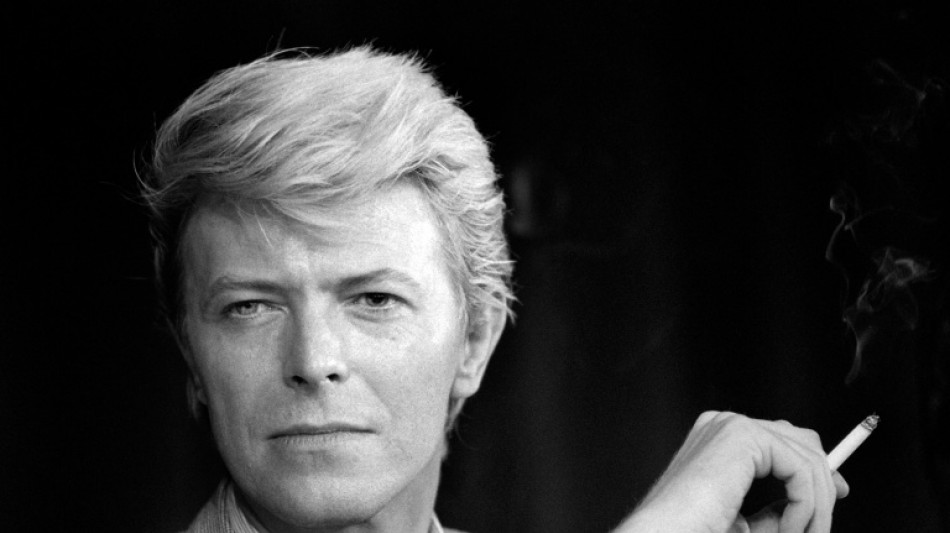
Home where young Bowie dreamt of 'fame' to open to public / Photo: Raph GATTI - AFP
With its grey front door and battered picket fence, No. 4 Plaistow Grove in the anonymous London suburb of Bromley is unremarkable in every way except for one.
The modest terraced house -- originally built as a railway workers' cottage in the late 19th century -- is the childhood home of pop phenomenon David Bowie.
An inscription on a small blue plaque to the right of the front door is the only clue to the property's extraordinary past.
"David Bowie Singer and Talented Musician 1955-1968," it reads, a reference to the 13 years that he spent living there.
Bowie, one of the most influential artists of the 20th century who died aged 69 in 2016, spent some of his most formative years here.
Now, the house has been acquired by a leading London heritage body which plans to turn it into a Bowie immersive experience.
Under the curatorship of Bowie expert Geoff Marsh it would be returned to the way it would have been when he was 16 in 1963 and opened to the public hopefully by the end of 2027.
The singer, real name David Jones, and his family moved into the property on the southeastern outskirts of the capital in 1955 when he was eight years old.
"It all started in this building," Marsh told AFP. "It was here that he changed from being an ordinary schoolboy to being determined to be a superstar."
- Step back in time -
Bowie lived in the house with his parents, Haywood and Peggy, and older half brother, Terry, a major creative influence who introduced him to modern jazz, Beat literature and Buddhism.
From 1966 onwards, however, Terry was no longer a constant presence at home due to a schizophrenia diagnosis which saw him in and out of psychiatric hospitals.
According to biographers, Peggy was emotionally distant towards Bowie, and their relationship included periods of estrangement.
Peggy moved out in 1970 following the death at home a year earlier of Haywood, aged just 56.
Once restored, people will be able to take a step back in time and experience the young Bowie's world, just as Beatles fans have done in Liverpool at the childhood homes of John Lennon and Paul McCartney.
Out will go the central heating, modern kitchen-diner extension and conservatory, plus the upstairs bathroom.
Back in will be a coal fire, outside lavatory, tiny kitchen and garage that once stood at the end of the garden.
It is located a stone's throw from the Sundridge Park railway station, from where Bowie "could get from what he saw as being very dull suburban life... straight into the West End, Soho, the music clubs there", Marsh said.
- Place to dream -
"It was that kind of culture in the 50s: keep your head down. Know who you are. Don't try and get above yourself," said Marsh, who curated the David Bowie Is exhibition at London's V&A museum in 2013.
"And David obviously just thought 'that's not for me. I want to be a success'. And music was his way out."
The main focal point will be the small 2.7 metre by three metre (9ft by 10ft) back bedroom where Bowie's creative journey began.
Bowie wrote his earliest songs here but struggled with rejection for five years before achieving his first major hit with "Space Oddity" in 1969.
In later life, Bowie described the bedroom as a place where he went to escape from his parents and dream.
But the singer, whose career was marked by a commitment to constant reinvention, also voiced a sense that the room had followed him around all his life, Marsh said.
He was "always, to some extent, running away from here", he added.
Heritage of London Trust director Nicola Stacey said she expected fans to find there was "nothing more powerful" than standing in the room.
Bowie had a record player and a tape recorder there as well as a saxophone bought for him by his father, who is said to have been more emotionally supportive.
- 'Moment of possibility' -
Other possible items that could feature include a photograph of Little Richard he bought from the Woolworths store when he was 10 and pinned to the wall. The picture remained with him all his life.
Friends of Bowie have recalled coming through the front door into a "rather austere house" with a "rather austere atmosphere", Stacey said.
"They would come up to David's room, and they would play music and look at all this Americana he was so interested in... and they just felt this sort of moment of possibility."
The project has also triggered memories from people who grew up in the area and recall seeing Bowie "wearing incredible outfits", Stacey said.
Bowie assembled and experimented with the outfits in his bedroom having purchased items from second-hand and surplus stores in central London's trendy Carnaby Street.
They knew there was something different about him and were sure he "was going to be something amazing", she added.
W.Atwal--BD