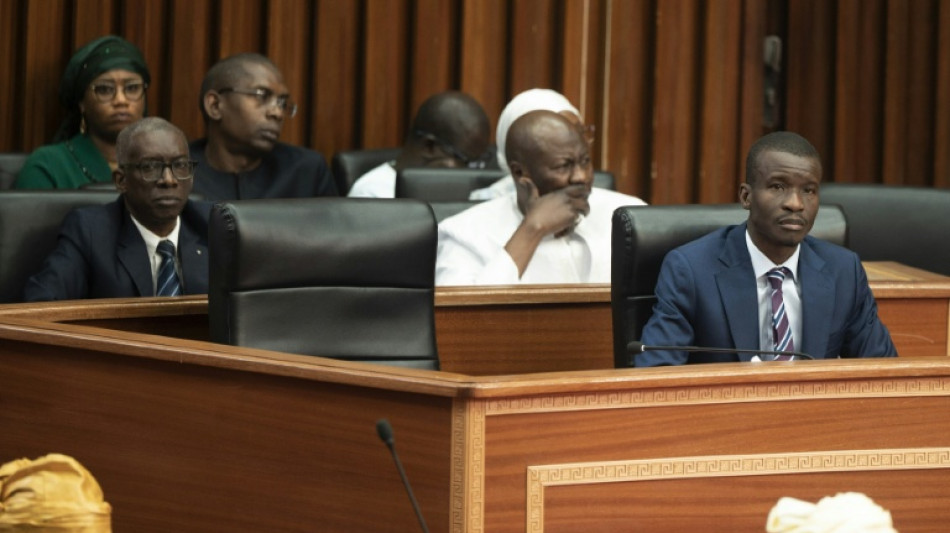
Senegal parliament doubles penalty for same-sex relations / Photo: SEYLLOU - AFP
Senegal's parliament on Wednesday passed legislation doubling the maximum penalty for same-sex relations, making them punishable by up to 10 years in prison amid a crackdown on the country's gay community.
The text, which must now be signed into law by President Bassirou Diomaye Faye, passed by an overwhelming majority in the National Assembly and also includes criminal penalties for those found guilty of promoting or financing same-sex relationships.
Media have reported the arrest of dozens of men under the country's anti-LGBTQ laws since February, when police arrested 12 men, including two local celebrities, at the start of a spate of recent detentions.
The bill punishes "acts against nature", a term used to signify same-sex relations, by five to 10 years' imprisonment, compared with one to five years previously.
It also provides for three to seven years in prison for anyone who engages in advocacy for same-sex relations.
Arrests have often been based on accusations and phone searches, which are reported almost daily, with the names of those detained made public.
The new law additionally penalises anyone who accuses another of same-sex offences "without proof".
After debating for several hours, lawmakers approved the bill by a vote of 135 in favour, zero opposed and three abstentions.
"Homosexuals will no longer breathe in this country. Homosexuals will no longer have freedom of expression in this country", lawmaker Diaraye Ba declared from the podium during the debate, to applause from some of her colleagues.
Under the bill, the maximum sentence will be handed down if the act was committed with a minor.
Punishment will additionally include fines from two million to 10 million CFA francs ($3,500 to $17,600), compared to 100,000 to 1.5 million CFA francs previously.
Some of those arrested have faced accusations of deliberately transmitting HIV, fuelling further fierce debate about same-sex relations.
- 'Walking dangers' -
In recent years, LGBTQ issues have stirred controversy in Senegal, where gay-rights advocacy is frequently denounced as a tool used by Westerners to impose foreign values.
Religious associations in the Muslim-majority west African country have staged demonstrations to demand tougher penalties.
Ousmane Sonko, before becoming the country's highly influential prime minister in 2024, had promised to make same-sex relations a crime, upping the offence from its current classification as misdemeanour.
However, the new law, which Sonko himself presented to parliament, maintains the same misdemeanour status.
This has led the opposition to accuse Sonko of failing to follow through on his promise.
Social media in Senegal have been flooded in recent weeks with homophobic messages and calls to out individuals accused of same-sex activity.
The highly publicized arrests have spawned headlines such as "Big homo clean-up" and "Bisexuals, walking dangers".
Stories in recent days have also conflated the arrests for same-sex relations with a separate child sex abuse affair.
In that case, investigators dismantled a gang accused of sexual violence against minors, arresting 14 people.
Repression of same-sex relations is politically advantageous in a country where homosexuality is widely regarded as deviant.
At least 32 out of Africa's 54 countries have laws on the books prohibiting and punishing same-sex relations.
The death penalty is imposed in Uganda, Mauritania and Somalia.
Approximately 10 countries or territories impose sentences ranging from 10 years to life in prison, including Sudan, Kenya, Tanzania and Sierra Leone.
R.Altobelli--BD